USAID DEC
Legalizing illegalities? Land titling and land tenure security in informal settlements
Sign inTHE UNIVERSITY OF ZAMBIA
Legalizing illegalities? Land titling and land tenure security in informal settlements
Land rights formalization has been a widely discussed topic in the context of informal settlements, particularly in sub-Saharan Africa.
2023 · 15 pages
Sign in to readA free account is required to download.
Abstract
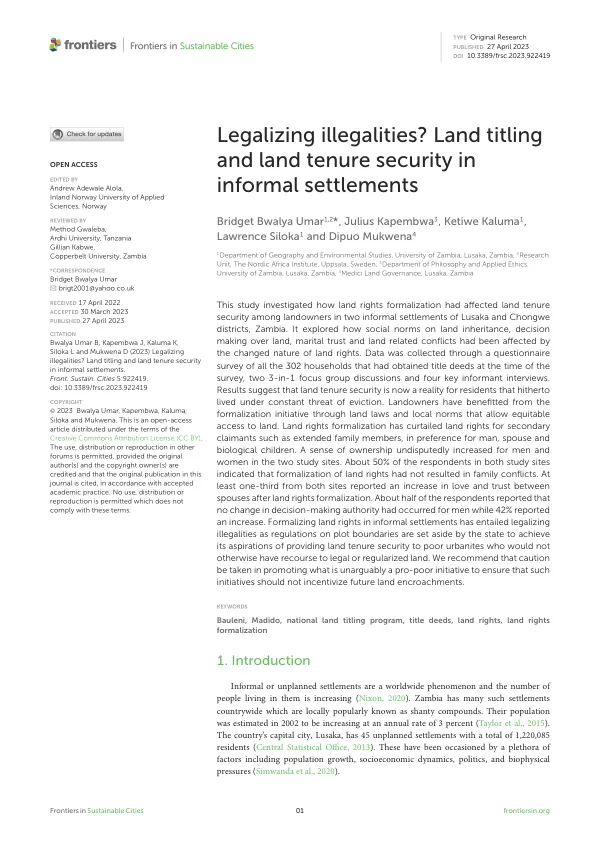
In Zambia, the issue of informal settlements has been a long-standing challenge, with a significant proportion of the population residing in unplanned areas. These settlements have been occasioned by a plethora of factors, including population growth, socioeconomic dynamics, politics, and biophysical pressures. According to the Central Statistical Office, Lusaka has 45 unplanned settlements with a total of 1,220,085 residents. These settlements have been a source of health, environmental, social, and moral problems, and have also led to the occupation and encroachment on contested spaces in the city. The houses in these settlements were built without any building authorization by the city municipality, making them unregistered and potentially resulting in diminished property rights and tenure insecurity. Tenure security refers to the degree of confidence held by people that they will not be arbitrarily deprived of their land rights or of the benefits derived from their land. Several scholars have observed that informality induces land tenure insecurity and has negative consequences on investments and land resources management. The lack of formal mechanisms for protecting property rights has been identified as a demotivating factor for the poor in developing countries. Formalization of property rights involves the provision of legal representation of property in the form of title deeds, licenses, permits, and contracts, all of which must receive official sanction and protection from legitimate national authorities. Land rights formalization is argued to be especially beneficial for residents of informal settlements, as the illegal status of such settlements presents a level of precariousness not experienced by other residents. By formalizing their land rights, residents of informal settlements can enhance their land rights claims and tenure security. Research has shown that land rights formalization can lead to a range of benefits, including access to credit, stimulating entrepreneurship, provision of services and infrastructure, improved health conditions, and the realization of the human right to adequate housing. However, the empirical evidence from several countries in sub-Saharan Africa that have implemented land formalization initiatives since 2000 reveals mixed results. Despite the numerous espoused benefits arising from titling programs, a variety of challenges impede implementation on a large scale, including the high costs required for land survey, title registration, and issuance of title. In Zambia, the national land titling program has been implemented to provide title deeds to residents of informal settlements. The program has been successful in providing land tenure security to residents, with a significant proportion of respondents indicating that formalization of land rights had not resulted in family conflicts. In fact, about one-third of respondents reported an increase in love and trust between spouses after land rights formalization. However, caution is recommended in promoting land rights formalization initiatives to ensure that such initiatives do not incentivize future land encroachments. The study investigated how land rights formalization had affected land tenure security among landowners in two informal settlements of Lusaka and Chongwe districts, Zambia. Data was collected through a questionnaire survey of all 302 households that had obtained title deeds at the time of the survey, two 3-in-1 focus group discussions, and four key informant interviews. The results suggest that land tenure security is now a reality for residents who hitherto lived under constant threat of eviction. Landowners have benefited from the formalization initiative through land laws and local norms that allow equitable access to land. The study also found that land rights formalization has curtailed land rights for secondary claimants, such as extended family members, in preference for men, spouses, and biological children. A sense of ownership has undoubtedly increased for men and women in the two study sites. The study recommends that caution be taken in promoting land rights formalization initiatives to ensure that such initiatives do not incentivize future land encroachments.