INTERNATIONAL FINANCE CORPORATION
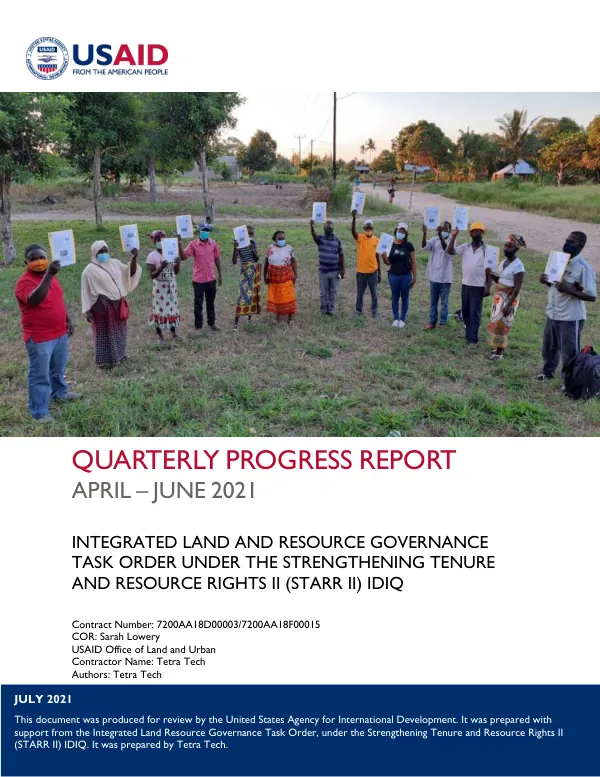
Integrated Land and Resource Governance (ILRG) Program
Integrated Land and Resource Governance (ILRG) is a program that supports USAID missions to implement activities that improve land rights, support inclusive land and resource governance, build resilient livelihoods, and promote women's economic empowerment.
2021 · 1 pages
Sign in to readA free account is required to download.
Abstract
The program is a partnership between USAID's Gender Equality and Women's Empowerment Hub and the Land and Resource Governance Division, working with governments, civil society organizations, local communities, and the private sector to strengthen women's land tenure security, inheritance rights, and decision-making power over land and natural resources in Ghana, India, Malawi, Mozambique, and Zambia. ILRG focuses on removing barriers to women's ownership and management of property and resources, directly addressing critical domains of women's economic empowerment, including women's agency and leadership, economic opportunities, access to markets, networks, and finance, and harmful gender norms. The program's efforts aim to promote women's land rights, support inclusive land and resource governance, and build resilient livelihoods. Key achievements on women's land rights from 2019 to 2020 include the documentation of over 26,000 women's land rights, with 4,558 women in Mozambique and 22,254 in Zambia. Additionally, over 3,000 women accessed resources and benefits related to secure land rights, such as credit, agricultural training, and livelihoods opportunities. In India, 500 women received agronomy training for the first time, and a land leasing pilot enabled women's groups to enter the PepsiCo potato supply chain. ILRG has established six private sector partnerships to support gender-responsive land investment and women's economic empowerment, including partnerships with PepsiCo in India, Ecom Agroindustrial in Ghana, MFinance in Zambia, and Green Resources AS, Novo Madal, and Portucel in Mozambique. The program has also promoted women's land rights in the documentation of both state and customary land in Zambia through partnerships with the Ministry of Lands and Natural Resources and the House of Chiefs. Women's representation as leaders on community resources boards in four chiefdoms in Zambia increased to 23 percent, improving women's meaningful participation in local natural resource governance. ILRG has also published new knowledge and evidence, including gender assessments, outcomes and lessons learned briefs/reports, and advocacy tools like blog posts on women's inheritance rights, gender equality in the wildlife sector, women's land leasing, empowering women farmers, and gender-based violence in land documentation.