USAID DEC
Lessons from Engaging the Private Sector in Latin America and the Caribbean: Alianza Forestal
Sign inAIDER
Lessons from Engaging the Private Sector in Latin America and the Caribbean: Alianza Forestal
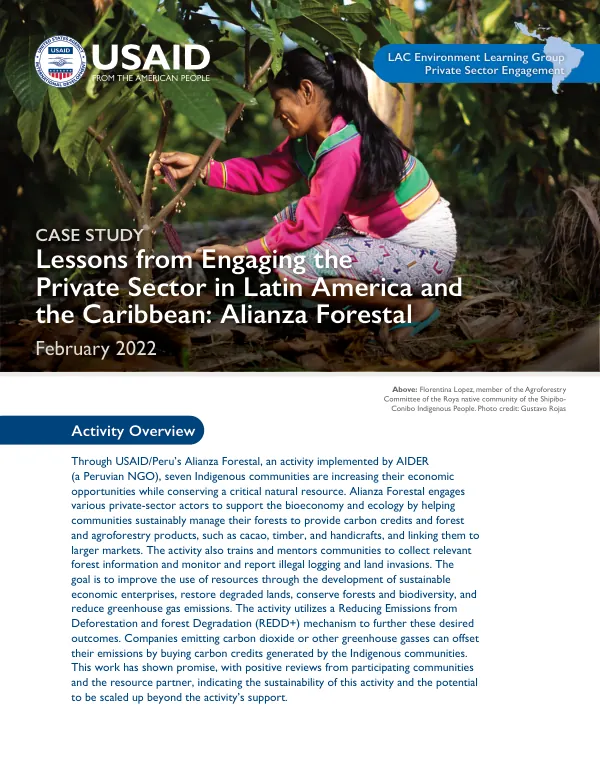
The Alianza Forestal activity, implemented by AIDER in Peru, aims to increase economic opportunities for Indigenous communities while conserving natural resources.
2022 · 6 pages
Sign in to readA free account is required to download.
Abstract
The activity engages private-sector actors to support the bioeconomy and ecology by helping communities sustainably manage their forests to provide carbon credits and forest and agroforestry products. This approach has shown promise, with positive reviews from participating communities and the resource partner, indicating the sustainability of this activity and the potential to be scaled up beyond the activity's support. The activity focuses on seven Indigenous communities in the Ucayali region, where land invasions and grabbing have resulted in deforestation and insecurity. Despite initial challenges, Alianza Forestal has contributed to improving the quality of life of Indigenous communities and protecting the forest, including 120,000 hectares under improved natural resource management and the generation of verified carbon credits associated with avoided emissions from deforestation. Private-sector partners, including Mirova Natural Capital, Nii Biri, Las Polleras de Agus, and Pruébalo, have played a crucial role in the activity's success. Mirova, a large impact investment fund, has provided project finance and linked Indigenous businesses to the market for increased income. Nii Biri connects small community enterprises to markets in Pucallpa and Lima, while Polleras de Agus and Pruébalo are retailers committed to selling products from the Ucayali region. The activity's collaborative approach, which involves co-creation and joint development of business plans, has been effective in engaging the private sector and ensuring all stakeholder voices are included from the beginning. This approach has fostered confidence among parties and created enabling conditions for private-sector actors to take greater risks. The success of Alianza Forestal can be attributed to several factors, including the trust and transparency built between USAID, AIDER, and private-sector partners. Careful and clear communication is essential to building trust when engaging the private sector and Indigenous communities in these activities. The activity's focus on co-investment and co-creation has also been critical in achieving its desired outcomes. In addition to its environmental and social benefits, Alianza Forestal has also generated economic benefits for Indigenous communities. The activity has enabled communities to gain additional income through carbon credit sales and has provided them with the resources to finance sustainable land management and train their enterprise staff. The Alianza Forestal activity has positioned itself as a sustainable and scalable model, with Mirova planning to invest in a second round of funding. Other private-sector actors have also expressed interest in partnering with AIDER on similar projects in other Indigenous communities in Peru. The activity's success highlights the potential for private-sector engagement to achieve environmental and development outcomes in Latin America and the Caribbean.
Related documents