USAID
Private Sector Engagement Strategy (PSES) for the Prevent Project
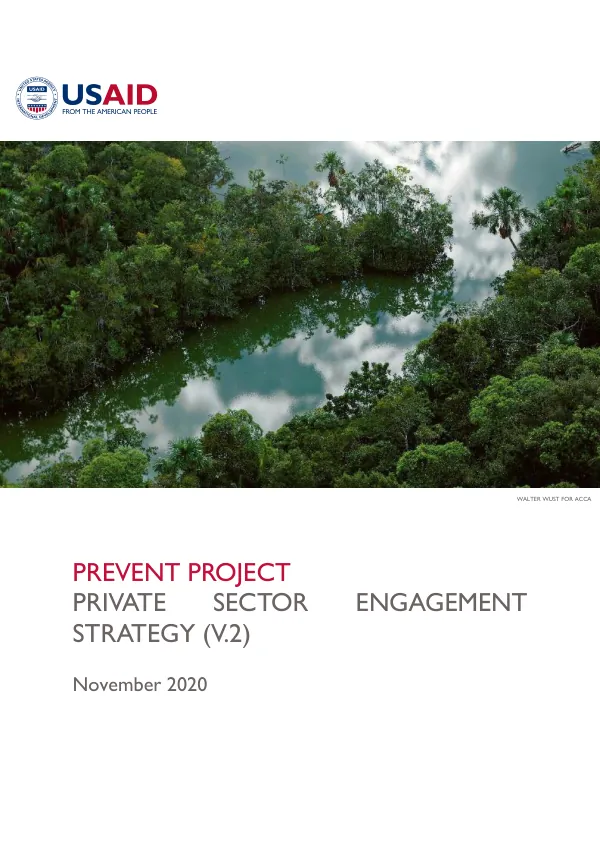
The Prevent Project's Private Sector Engagement Strategy (PSES) aims to establish strategic and tactical guidelines for building alliances with key private-sector stakeholders to prevent and reduce environmental crimes in the Peruvian Amazon.
2020 · 45 pages
Sign in to readA free account is required to download.
Abstract
The strategy is part of USAID's Green Amazon Initiative and operates in the prioritized regions of Loreto, Madre de Dios, and Ucayali. Prevent's objective is to improve enabling conditions for preventing and combating environmental crimes, reduce and prevent environmental criminal activity within protected areas, and build partnerships to mobilize resources to support the prevention and reduction of environmental crimes. The private sector is a key stakeholder in addressing environmental crimes and creating economic incentive structures for legal activities. To support the Government of Peru (GOP) in developing and accelerating a culture of legality, Prevent's strategy for private sector engagement centers on the mutual benefits of legal logging and mining. The private sector is essential for mobilizing resources, promoting innovations, and introducing market-based solutions to sustainably address environmental crimes. Prevent has developed a Private Sector Landscape Analysis Report (PSLAR) to provide vital information on opportunities for collaboration and alliances with private-sector stakeholders. The report highlights the current contributions to the conservation of the Amazon and future willingness for that purpose. The PSLAR has been used as a general framework for the Peruvian private-sector engagement strategy. Prevent has developed two prioritization criteria to determine the order in which it will build strategic alliances with stakeholders in three strategic lines of action. The criteria include willingness to ally and connection with Amazon conservation activities, and stakeholder's desired or anticipated timeframe for participation in alliances. A classification criterion has also been defined by the potential types of contribution identified. Prevent aims to build alliances with stakeholders beyond those identified in the PSLAR. The project will monitor the political, economic, and social context and the changes that may result in the stakeholders' willingness to contribute to the prevention and reduction of environmental crimes. Prevent will continue engagement with the private sector through the implementation of the grant program, the Innovation Fund, and activities and opportunities identified as a result of the analytical studies of relevant value chains in Loreto, Madre de Dios, and Ucayali. The strategy also includes a risk analysis of the private-sector stakeholders identified by the PSLAR, following the classification proposed by USAID's Private-Sector Engagement Policy. The analysis will be continually updated, as the study only reflects the stakeholders' current situation and it is impossible to predict the way they will act in the future. Prevent will actively monitor the challenges and opportunities of COVID-19 on economic activities and private-sector participation in election campaigns. The strategy aims to identify opportunities to leverage private-sector financing and investment that will strengthen formal value chains, increase the costs of illegal activities, and improve opportunities for creating alternative livelihoods in the Peruvian Amazon. The Prevent PSES has been developed in alignment with USAID's Private-Sector Engagement Policy guidelines. The strategy formulates strategic guidelines for effective negotiation and for making mutually beneficial alliances with the private sector more likely. The objective of the PSES is to establish guidance to build alliances with potential private-sector stakeholders to successfully mobilize additional resources that will help prevent and reduce environmental crimes in the Amazon. Prevent's theory of change is based on the idea that by building alliances with private-sector stakeholders, the project can mobilize additional resources to prevent and reduce environmental crimes in the Amazon. The theory of change is based on the following assumptions: * The private sector can play a key role in addressing environmental crimes and creating economic incentive structures for legal activities. * By building alliances with private-sector stakeholders, Prevent can mobilize additional resources to support the prevention and reduction of environmental crimes. * The private sector can help to strengthen formal value chains, increase the costs of illegal activities, and improve opportunities for creating alternative livelihoods in the Peruvian Amazon. The Prevent PSES has been developed to support the achievement of the project's main objectives, including improving enabling conditions for preventing and combating environmental crimes, reducing and preventing environmental criminal activity within protected areas, and building partnerships to mobilize resources to support the prevention and reduction of environmental crimes.
Related documents