USAID DEC
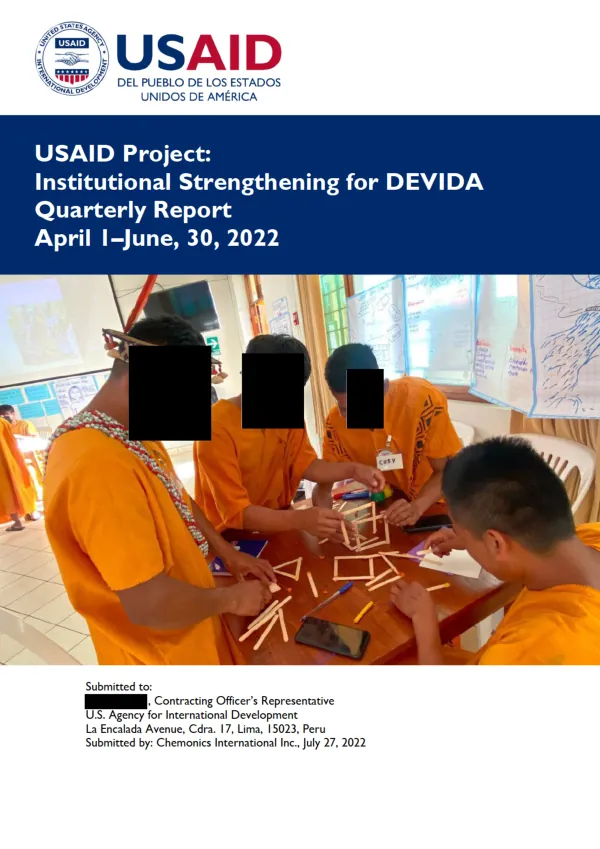
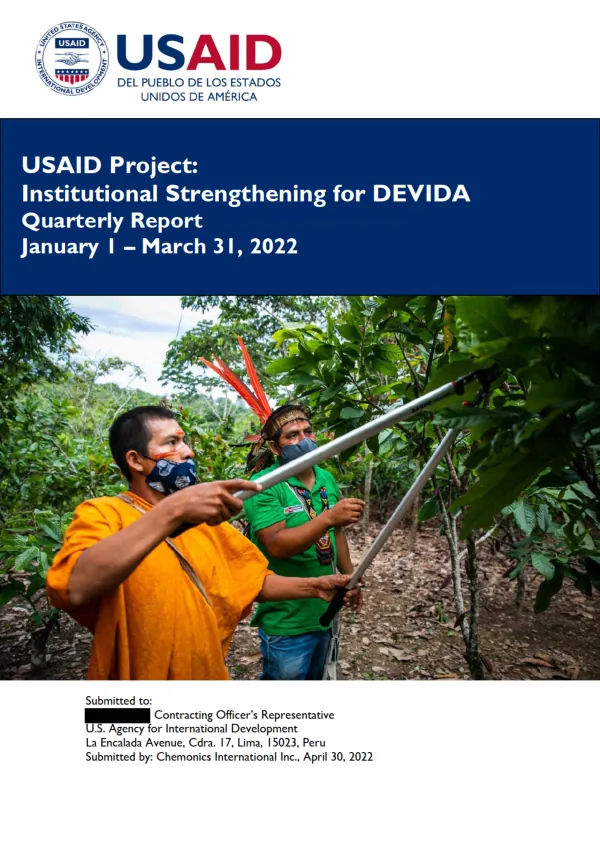
Institutional Strengthening for DEVIDA Quarterly Report, January 1 to March 31, 2022
Sign inCHEMONICS
Institutional Strengthening for DEVIDA Quarterly Report, January 1 to March 31, 2022
The Institutional Strengthening for DEVIDA project, implemented by Chemonics International Inc.
2022 · 79 pages
Sign in to readA free account is required to download.
Abstract
for the USAID project, aims to enhance the capacity of the National Commission for Development and Life without Drugs (DEVIDA) in Peru. The project focuses on three components: Component 1, which seeks to improve DEVIDA's ability to facilitate state presence and deliver post-eradication assistance; Component 2, which aims to organize communities to define, advocate for, and implement social and economic development priorities; and Component 3, which aims to enhance national and sub-national governments' response to the demand for services and facilitate conditions for local economic development in targeted areas. Component 1 involves strengthening DEVIDA's institutional capacity, including the development of a strategic plan, improvement of communication and coordination with other government agencies, and enhancement of its monitoring and evaluation system. Component 2 focuses on community organization and participation, including the establishment of community councils and the development of community-led plans for social and economic development. Component 3 aims to improve the responsiveness of national and sub-national governments to the needs of communities, including the development of a multi-year planning and management system for investments. The project also involves the implementation of various activities, including the provision of technical assistance to DEVIDA and other government agencies, the development of institutional capacity-building programs, and the implementation of community-led projects. The project's geographic focus is on the Valley of the Apurímac, Ene, and Mantaro rivers (VRAEM) region in Peru, which is one of the most vulnerable regions in the country. The project's implementation is guided by a quarterly reporting system, which provides updates on progress, challenges, and lessons learned. The report highlights the importance of community participation and ownership in the project's success, as well as the need for continued support and resources to ensure the sustainability of the project's outcomes. The project's monitoring and evaluation system includes the use of various indicators, including the Institutional Capacity Index (ICI) and the Social Capital Index (ICS), to assess the project's impact on DEVIDA's institutional capacity and community development outcomes. The report also highlights the importance of collaboration and coordination among project stakeholders, including DEVIDA, government agencies, and civil society organizations. The project's budget for the quarter ending March 31, 2022, was $1.2 million, which was allocated to various activities, including technical assistance, institutional capacity-building, and community-led projects. The report highlights the importance of continued funding and support to ensure the project's sustainability and impact. The project's implementation is also guided by a gender and interculturality (GI) approach, which aims to promote the participation and inclusion of women and indigenous communities in the project's activities and decision-making processes. The report highlights the importance of this approach in ensuring the project's success and sustainability. Overall, the Institutional Strengthening for DEVIDA project aims to enhance the capacity of DEVIDA and other government agencies to deliver effective and sustainable development outcomes in the VRAEM region of Peru. The project's implementation is guided by a quarterly reporting system, which provides updates on progress, challenges, and lessons learned.