USAID DEC
Lessons from Latin America and the Caribbean for Improving Contraceptive Procurement
Sign inUSAID | PROJECTO DELIVER
Lessons from Latin America and the Caribbean for Improving Contraceptive Procurement
Contraceptive procurement in Latin America and the Caribbean is a complex process that requires careful planning and execution to ensure the delivery of high-quality products.
2009 · 12 pages
Sign in to readA free account is required to download.
Abstract
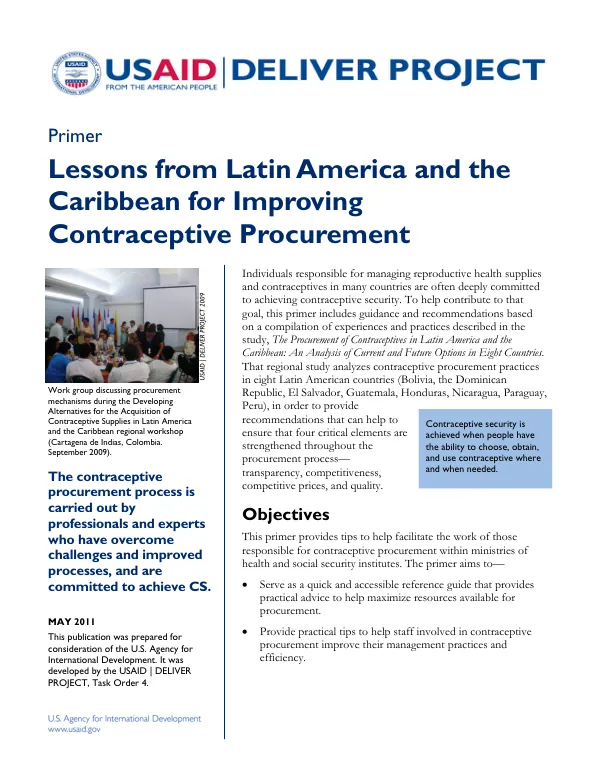
The USAID | DELIVER PROJECT 2009 Work Group discussed procurement mechanisms during the Developing Alternatives for the Acquisition of Contraceptive Supplies in Latin America and the Caribbean regional workshop in Cartagena de Indias, Colombia in September 2009. The contraceptive procurement process involves several stages, including programmatic planning, procurement, and performance monitoring. Programmatic planning is critical to ensure that forecasts are accurate and sufficient funding is available to meet demand. This stage involves estimating needs, reviewing product delivery, selecting products, establishing quality control processes, defining specifications, analyzing procurement options, and defining the budget and ensuring funding. Procurement is the stage where the actual purchase of contraceptives takes place. This involves planning the purchase, defining the tender, developing documents and inviting bidders, selecting the supplier, preparing the contract, and monitoring the contract. Transparency, competitiveness, competitive prices, and quality are critical elements that must be strengthened throughout the procurement process. The procurement process can be facilitated by using reliable data sources, developing long-term projections, and carefully integrating contraceptive forecasting and quantification into the procurement process. This can be achieved by using tools such as PipeLine software, which has been used by the Ministry of Public Health and Social Assistance in El Salvador since 2002 to aggregate and prepare forecasts. Effective programmatic planning and procurement can help to ensure that contraceptive security is achieved, which is defined as the ability of people to choose, obtain, and use contraceptives where and when needed. This can be achieved by strengthening the four critical elements of the procurement process: transparency, competitiveness, competitive prices, and quality. In El Salvador, improved forecasting and quantification helped to achieve appropriate inventory levels, which in turn helped to reduce unmet need and improve the delivery of high-quality contraceptives. This was achieved by coordinating among the family planning program, logistics staff, central medical stores, procurement and planning units, and regional level representatives. The USAID | DELIVER PROJECT 2009 Work Group recognized the importance of transparency, competitiveness, competitive prices, and quality in the procurement process. They also emphasized the need for careful planning and execution to ensure the delivery of high-quality products. By following these principles and using tools such as PipeLine software, countries in Latin America and the Caribbean can improve their contraceptive procurement processes and achieve contraceptive security. In addition to using reliable data sources and developing long-term projections, countries can also improve their procurement processes by coordinating forecasting and quantification among the procurement unit, central medical stores, and those responsible for the family planning program at different system levels. This type of coordination and joint effort facilitates the procurement of an adequate quantity of high-quality contraceptive commodities.
Related documents