DEPARTMENT FOR INTERNATIONAL DEVELOPMENT
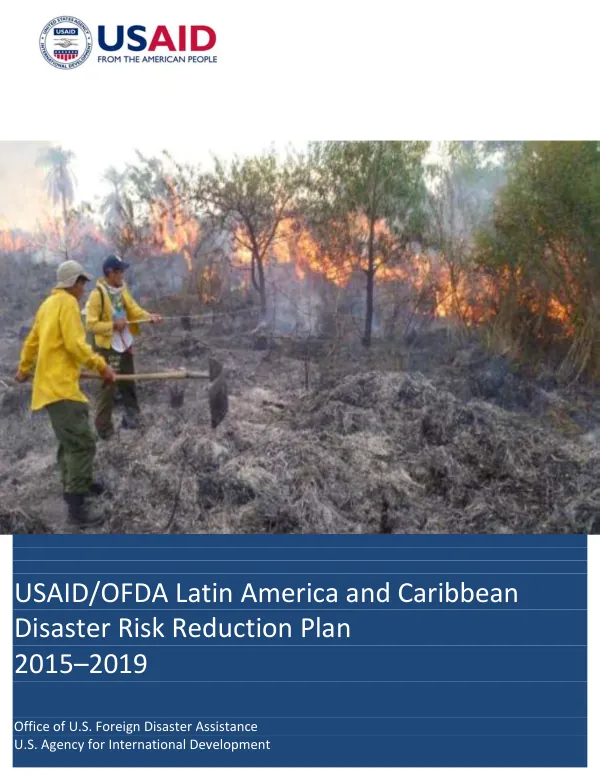
USAID/OFDA LAC Disaster Risk Reduction Plan, 2015–2019
The USAID/OFDA Latin America and Caribbean Disaster Risk Reduction Plan, 2015-2019, outlines the regional context and challenges in adopting disaster risk reduction (DRR) practices in the LAC region.
2015 · 19 pages
Sign in to readA free account is required to download.
Abstract
The plan builds on previous USAID/OFDA LAC DRR plans and supports the U.N. International Strategy for Disaster Reduction (UNISDR) Hyogo Framework for Action (HFA), 2005-2015. The USAID/OFDA LAC regional office, headquartered in San José, Costa Rica, was established in 1983. Initially, the office focused primarily on responding to emergencies. However, following a series of highly destructive events in the region between 1985 and 1986, USAID/OFDA LAC convened a set of meetings with key actors and charted a multi-stage, ten-year program to increase in-country disaster response capabilities. This training initiative has evolved to include a multi-layered program providing specialized, targeted technical assistance known as the Regional Disaster Assistance Program (RDAP). The RDAP provides training and technical assistance for both response and DRR activities. In addition to RDAP, USAID/OFDA LAC supports stand-alone DRR initiatives to improve preparedness and to mitigate and prevent the worst impacts of disasters in the LAC region. At the regional and country levels, USAID/OFDA LAC and implementing partners engage communities, local and national governments, international and regional organizations, and non-governmental organizations to develop effective strategies - tailored to the needs of at-risk populations - to reduce the risk of disasters. An ever-widening set of actors participate in the planning and implementation of DRR interventions in the LAC region. At the international level, USAID/OFDA LAC coordinates with other donors and international organizations such as the Canadian International Development Agency, Swiss Development Cooperation, Japanese International Cooperation Agency, the U.K. Department for International Development, the European Union, the World Bank, and various U.N. agencies. Strong partnerships with these international organizations help USAID/OFDA LAC prioritize geographic areas and themes, coordinate programs, and where possible leverage additional resources. On a regional level, USAID/OFDA LAC works closely with organizations such as the Caribbean Disaster Emergency Management Agency and the Center for the Prevention of Natural Disasters in Central America. USAID/OFDA LAC also intends to engage with regional development banks to strengthen DRR considerations in project design and implementation. The USAID/OFDA LAC Disaster Risk Reduction Plan, 2015-2019, outlines five key priorities for DRR activities in the LAC region. These priorities are guided by the HFA and are designed to support the development of effective DRR strategies and programs in the region. The priorities include: 1. Ensuring that DRR is a national and local priority with a strong institutional basis for implementation. 2. Identifying, assessing, and monitoring disaster risks and enhancing early warning systems. 3. Using knowledge, innovation, and education to build a culture of safety and resilience at all levels. 4. Reducing underlying risk factors that contribute to disaster vulnerability. 5. Strengthening disaster preparedness for effective response at all levels. The plan also outlines the key principles and approaches that USAID/OFDA LAC will use to select DRR activities and programs in the LAC region. These principles and approaches include building capacity, community-based DRR, inclusive programming that accounts for high-risk populations, evidence-based learning and good practices, and innovation. The plan also outlines the key program elements and activities that USAID/OFDA LAC will implement to support DRR activities in the LAC region.