USAID DEC
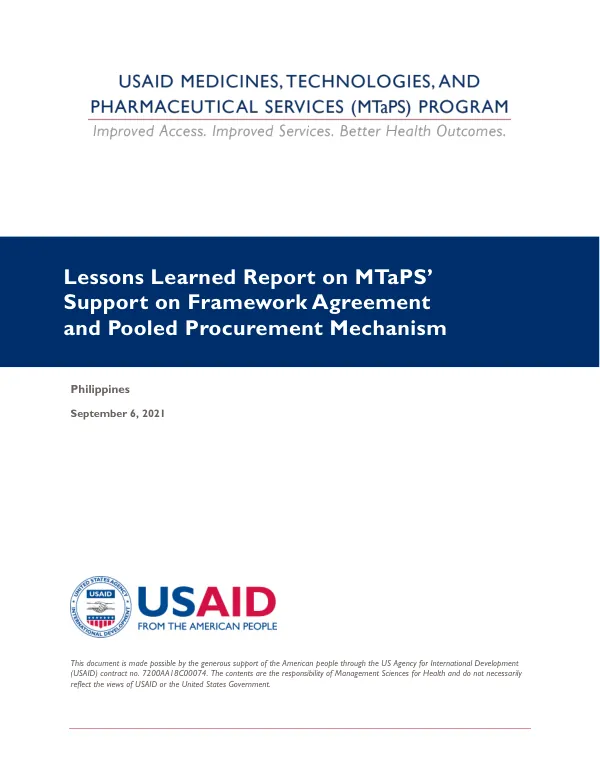
Lessons Learned Report on MTaPS' Support on Framework Agreement and Pooled Procurement Mechanism
Sign inDELOITTE USA
Lessons Learned Report on MTaPS' Support on Framework Agreement and Pooled Procurement Mechanism
The USAID Medicines, Technologies, and Pharmaceutical Services (MTaPS) Program was implemented in the Philippines from September 20, 2018, to September 19, 2023.
2021 · 17 pages
Sign in to readA free account is required to download.
Abstract
The program aimed to strengthen the country's pharmaceutical systems, improve access to essential medical products, and ensure the appropriate use of medicines to achieve better health outcomes. The MTaPS Program was led by Management Sciences for Health (MSH) and implemented by a consortium of global and local partners. The program focused on improving the procurement mechanisms for medicines in the Philippines, particularly in the context of the Universal Health Care (UHC) Law (Republic Act 11223). The law aimed to provide universal access to quality health care, including affordable medicines. However, the lack of a sufficient supply of health commodities in public health facilities across the country posed a major challenge. To address this challenge, the MTaPS Program supported the Philippine Department of Health (DOH) in drafting and finalizing an administrative order (AO) to guide the implementation of framework contracting and pooled procurement of drugs, medical devices, and supplies for Centers for Health and Development (CHDs) and DOH hospitals. The program also promoted the use of multiyear framework agreements (FAs) to ensure an uninterrupted supply of health commodities. The MTaPS Program recognized the importance of strategic procurement mechanisms, such as pooled procurement and FAs, in improving access to and availability of affordable medicines in the country. Pooled procurement can help small contracting authorities and increase the purchasing power of the government, allowing for better price negotiations and supplier monitoring. The program also highlighted the need for capacity building of government agencies, including local government units (LGUs), on forecasting of appropriate quantities of health commodities and the use of parallel importation and partnerships with local manufacturers for direct sourcing. The program's efforts were focused on the Bangsamoro Autonomous Region in Muslim Mindanao (BARMM), where the DOH and CHDs were encouraged to pursue and adapt effective and efficient mechanisms for procuring medicines. The program also worked with the Philippine Pharmaceuticals Procurement, Incorporated (PPPI), a government-mandated entity that can conduct pooled procurement for both public and private health facilities. The MTaPS Program's support for the Philippine DOH in drafting and finalizing the AO on framework contracting and pooled procurement was a critical step in improving the country's pharmaceutical systems. The program's efforts to promote strategic procurement mechanisms and capacity building of government agencies will have a lasting impact on the country's ability to provide universal access to quality health care, including affordable medicines. The program's success was measured by the increased adoption of framework contracting and pooled procurement mechanisms by CHDs and DOH hospitals. The program also facilitated the development of a Pooled Procurement Facility for Medicines, which will provide funding support for stockpiling and an information system for inventory, ordering, and related services. The program's legacy will continue to benefit the country's pharmaceutical systems, ensuring that the Filipino people have access to affordable and quality medicines. The MTaPS Program's experience in the Philippines highlights the importance of strategic procurement mechanisms in improving access to and availability of affordable medicines. The program's success demonstrates that with the right support and guidance, countries can strengthen their pharmaceutical systems and provide universal access to quality health care.