DELOITTE USA
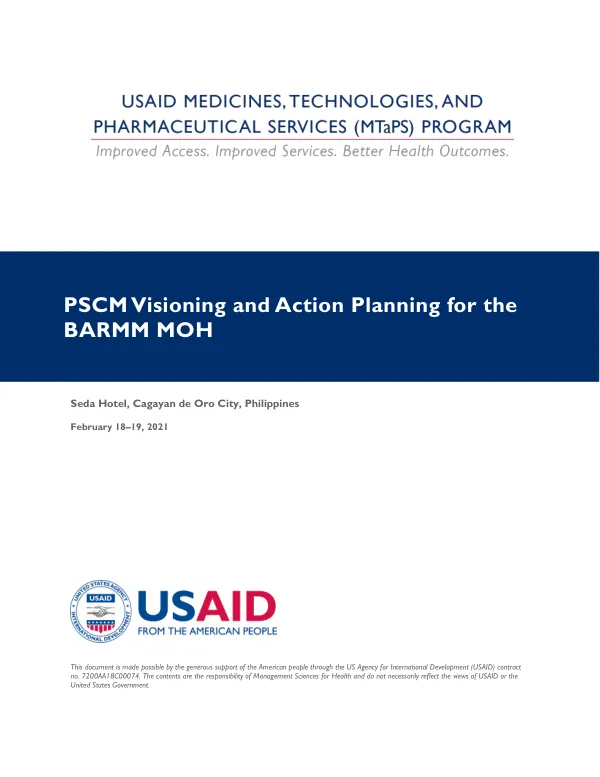
PSCM Visioning and Action Planning for the BARMM MOH
The Bangsamoro Autonomous Region of Muslim Mindanao (BARMM) was formally established in the Philippines in 2019 through Republic Act 11054, also known as the Organic Law for the BARMM.
2021 · 31 pages
Sign in to readA free account is required to download.
Abstract
This law granted BARMM self-governance and allowed it to manage its own health system outside the national Department of Health (DOH). As a result, BARMM is responsible for managing its own procurement and supply chain management (PSCM) system for medicines and health commodities. The pharmaceutical supply chain is a complex process involving multiple stakeholders, including manufacturers, wholesale distributors, and pharmacy retailers. Incorrectly distributed health commodities can have negative consequences, including reputational damage, increased costs, and adverse patient health outcomes. To address these challenges, the US Agency for International Development (USAID) Medicines, Technologies, and Pharmaceutical Services (MTaPS) Program partnered with USAID BARMMHealth to enhance the current PSCM system of the BARMM Ministry of Health (MOH). The goal of the workshop, held on February 18-19, 2021, at the Seda Hotel, Cotabato City, was to identify gaps and specific strategies to optimize the current PSCM systems. The objectives of the workshop were for participants to be able to describe best practices and approaches for a future state PSCM system for BARMM, envision the impact of a functional PSCM system and corresponding roles, and describe the current state of BARMM in areas such as PSCM governance, human resources, information systems, financing, and service delivery. The target audiences for the workshop were BARMM MOH central- and regional-level office staff responsible for managing the supply chain and pharmaceutical procurement. Additionally, participants from the provinces of Lanao Del Sur, Marawi, and Maguindanao were included. A total of 50 identified stakeholders were involved, with 35 participants attending the workshop. The workshop was facilitated by MTaPS and USAID BARMMHealth, with remote support provided by MTaPS. The two-day workshop included multiple presentations and group discussion sessions on PSCM. The presentations covered topics such as supply chain management in the context of pharmaceutical systems strengthening and universal health care, and were followed by open forums to allow interaction with participants. The workshop aimed to create a general understanding of each topic and to facilitate collaboration among participants. The presentations and discussions were designed to enable participants to describe best practices and approaches for a future state PSCM system for BARMM, envision the impact of a functional PSCM system and corresponding roles, and describe the current state of BARMM in areas such as PSCM governance, human resources, information systems, financing, and service delivery. The workshop also aimed to identify possible pain points in the current state for treatment guidelines, product registration, health technology assessment, formulary inclusion, governance framework, human resources, information systems, financing, and service delivery resources. The ultimate goal was to define PSCM strategies collaboratively and to develop a plan to implement these strategies. The workshop was an important step in enhancing the PSCM system of the BARMM MOH. By bringing together stakeholders and facilitating collaboration, the workshop aimed to create a functional PSCM system that would improve the availability and accessibility of medicines and health commodities in BARMM.
Related documents