USAID DEC
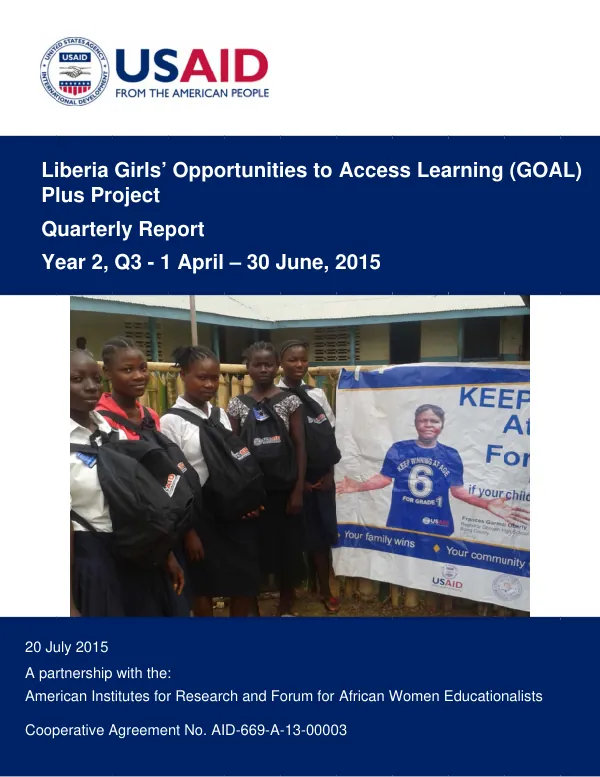
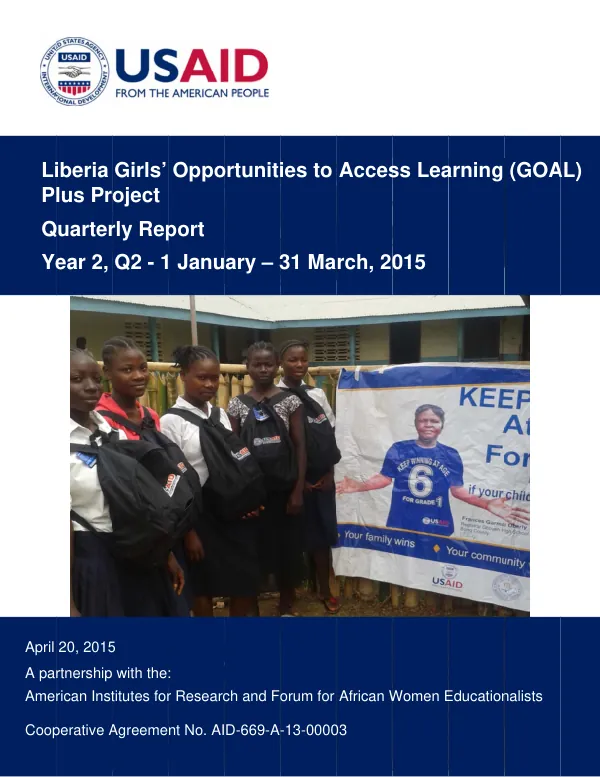
Liberia Girls' Opportunities to Access Learning (GOAL) Plus Project Quarterly Report Year 2, Q2 - 1 January – 31 March 2015
Sign inTHE AMERICAN INSTITUTES FOR RESEARCH
Liberia Girls' Opportunities to Access Learning (GOAL) Plus Project Quarterly Report Year 2, Q2 - 1 January – 31 March 2015
The Girls' Opportunities to Access Learning (GOAL) Plus project is a two-year United States Agency for International Development (USAID)-supported activity implemented by a partnership comprised of the American Institutes for Research (AIR) and the Forum for African Women Educationalists (FAWE) Liberia.
2015 · 42 pages
Sign in to readA free account is required to download.
Abstract
The project aims to improve primary school girls' enrollment, attendance, retention, and completion in 60 schools in Bong, Lofa, and Grand Bassa counties. To achieve this goal, GOAL Plus offers a scholarship program to improve girls' access, Parent Teacher Association (PTA) capacity building and community grants to improve the learning environments of schools, an outreach awareness campaign to create support among parents and communities for girls' education and appropriate age enrollment, whole-school health interventions, support to the Ministry of Education (MOE) on topics related to girls' education, and capacity building support to FAWE to strengthen their finance, administration, logistics, and monitoring and evaluation (M&E) activities. Research and evaluation activities have been planned to provide evidence concerning the performance of key interventions and issues that influence girls' success in education to inform the policy dialogue and programming related to girls' education. The second quarter of the second year of the GOAL Plus project, January-March 2015, was a more optimistic period than the previous quarter, which had been defined primarily by the Ebola Virus Disease outbreak. At the start of the quarter, GOAL Plus resumed full operations preparing for schools to re-open. Though with a slow start, schools officially opened in February 2015. Project staff began to return to the field, and the expatriate Chief of Party (COP) returned to Liberia to hand over his role to a new COP, Dr. Leesa Kaplan-Nunes, who will remain until the end of the project. This quarter, project staff focused on the distribution of the girls' assistance packages and participated in MOE technical working groups to develop and implement the MOE's Emergency Response Plan, including GOAL Plus' role within the plan. Staff also returned to the communities to provide guidance and support for their completion of the grant-supported school improvement activities and to hold experience sharing and grant closeout meetings. The project contributed to the development of MOE Ebola response programs, procurement and delivery of WASH supplies and Ebola awareness information for the project-supported schools/communities, procurement and packaging of the scholarship materials, and instituting academic support activities while schools remained closed. COP Dr. Howard Williams continued working remotely in January 2015 and traveled to Liberia in February, when he transitioned his role to Dr. Leesa Kaplan-Nunes, who was approved by USAID on January 20 and arrived in Liberia in mid-February. Dr. Williams participated in the annual Comparative and International Education Society (CIES) conference and presented a session on the "Education Response to the Ebola Health Crisis in Liberia," at no cost to USAID. The GOAL Plus Project Manager also attended the conference and presented the "Research Findings from GOAL." Panelists discussed the components of the GOAL research, including the project design, implementation, and outcomes, the impact of the program, cost-effectiveness analysis, and a GIS-based model that can be used to help develop plans for expanding the interventions in Liberia. During this period, AIR updated and submitted a revised Year 2 Quarter 1 Report, incorporating changes that responded to USAID queries and comments. Regular weekly project updates were also submitted to USAID. AIR also delivered a revised Annual Work Plan to USAID. Dr. Leesa Kaplan-Nunes, incoming COP, attended the AIR COP Summit in Washington, DC from March 30 to April 1, 2015 at no cost to USAID. The GOAL Plus project collaborated with the MOE and USAID on the Emergency Ebola Response Plan while continuing work within its Results Framework. Activities in support of the Emergency Plan included contributing to the development of MOE Ebola response programs, procurement and delivery of WASH supplies and Ebola awareness information for the project-supported schools/communities, and instituting academic support activities while schools remained closed. The project also continued to implement its Results Framework, which includes activities such as the scholarship program, PTA capacity building, and whole-school health interventions. The project's scholarship program aimed to improve girls' access to education by providing financial support to girls who were unable to attend school due to financial constraints. The program was implemented in partnership with the MOE and USAID, and it provided scholarships to over 1,000 girls in the project's target schools. The project also implemented a PTA capacity building program, which aimed to improve the learning environments of schools by building the capacity of PTAs to manage and maintain schools. The project's whole-school health interventions aimed to improve the health and well-being of girls in the project's target schools. The interventions included the provision of WASH supplies, Ebola awareness information, and academic support activities while schools remained closed. The project also collaborated with the MOE and USAID on the Emergency Ebola Response Plan, which aimed