FHI 360
LINKAGES India Quarterly Newsletter January-March 2019
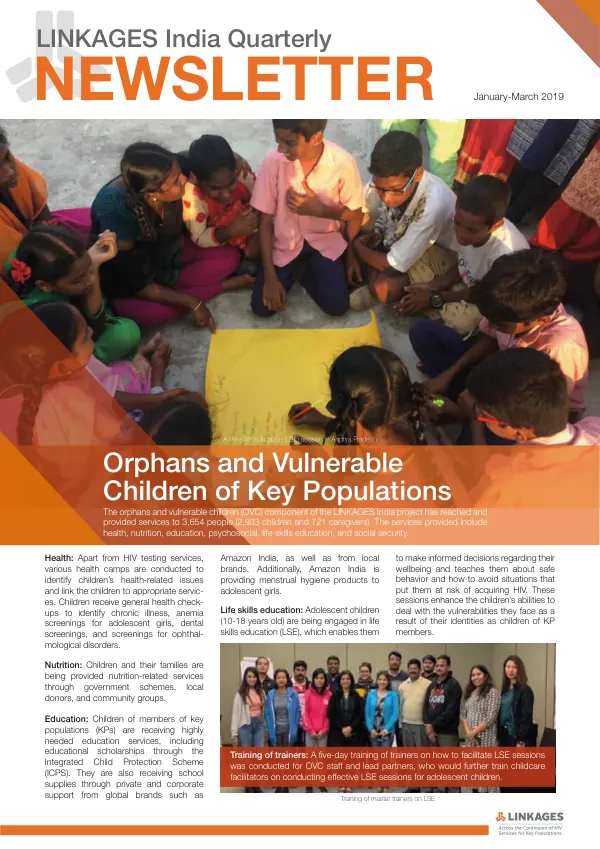
The LINKAGES India project has been working to address the needs of orphans and vulnerable children of key populations, including those affected by HIV.
2019 · 8 pages
Sign in to readA free account is required to download.
Abstract
The project has provided a range of services, including health, nutrition, education, and life skills education. These services have been delivered through a network of community-based organizations and government agencies. In the area of health, the project has conducted health camps to identify children's health-related issues and link them to appropriate services. Children have received general health check-ups, screenings for chronic illness, anemia, dental issues, and ophthalmological disorders. The project has also provided nutrition-related services through government schemes, local donors, and community groups. Education has been a key focus of the project, with children of key population members receiving educational scholarships through the Integrated Child Protection Scheme. The project has also provided school supplies through private and corporate support from global brands such as Amazon India. Additionally, Amazon India has provided menstrual hygiene products to adolescent girls. Life skills education has been provided to adolescent children, enabling them to make informed decisions regarding their wellbeing and teaching them about safe behavior and how to avoid situations that put them at risk of acquiring HIV. The project has also conducted training of trainers on how to facilitate life skills education sessions for adolescent children. In the area of HIV treatment, the project has implemented two community-based antiretroviral therapy (ART) service delivery models. The first model, the Linked ART Centre (LAC) targeted intervention co-location model, was inaugurated on March 6, 2019, in Mumbai. The second model, the integrated care delivery model, was inaugurated on March 7, 2019, at The Humsafar Trust in Mumbai. These models provide ART re-fills, adherence counselling and support, care for minor opportunistic infections, and referrals for CD4, viral load testing, and major opportunistic infections. The project has also strengthened its efforts to retain people living with HIV (PLHIV) on treatment through a real-time ART adherence monitoring project using an information and communication technology (ICT) called 'self-verified adherence' (SVA). This project enables remote observation of ART pill adherence among PLHIV and has the potential to improve ART adherence outcomes. In addition to these efforts, the project has completed the pilot phase of the RETHINK HIV Grand Challenge, which aimed to reach high-risk populations in virtual spaces. Three innovators, Jubi.ai, OneKeyCare Venture, and Twistle, developed out-of-the-box ideas to address HIV-related issues, including a conversational platform powered by artificial intelligence, a microgame to incentivize dating app users to play a short game on perceptions about HIV, and a website to engage users at risk of contracting HIV. The project has also worked to address the needs of transgender people and men who have sex with men (MSM), who face compounded inequalities due to social stigma, violence, high levels of criminalization, and fear of identity disclosure. The project's enhanced peer outreach approach (EPOA) has helped to reach these hidden populations and provide them with the services they require.