USAID DEC
FIELD ACTION REPORT Getting to the First 90: Incentivized Peer Mobilizers Promote HIV Testing Services to Men Who Have Sex With Men Using Social Media in Mumbai, India
Sign inFHI 360
FIELD ACTION REPORT Getting to the First 90: Incentivized Peer Mobilizers Promote HIV Testing Services to Men Who Have Sex With Men Using Social Media in Mumbai, India
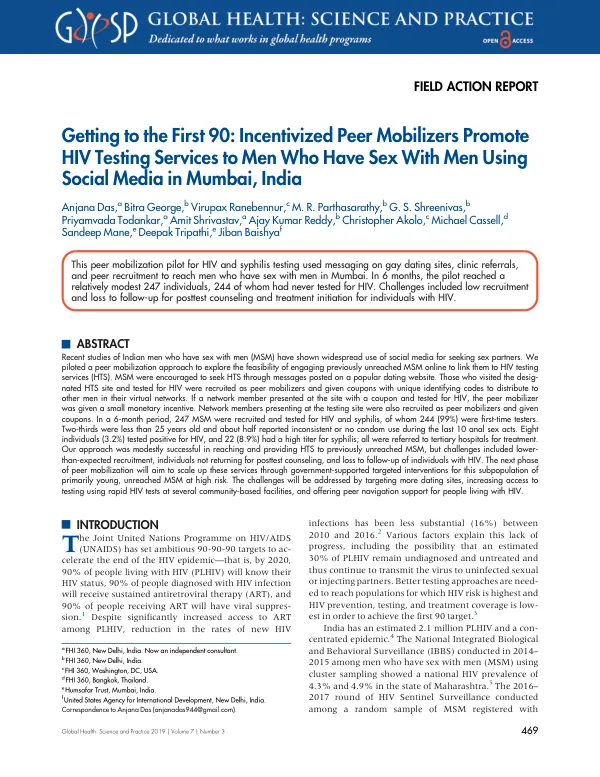
The peer mobilization pilot for HIV and syphilis testing in Mumbai, India, aimed to reach men who have sex with men (MSM) through messaging on gay dating sites, clinic referrals, and peer recruitment.
2019 · 9 pages
Sign in to readA free account is required to download.
Abstract
The pilot was conducted from January to July 2017 and targeted MSM who used social media to seek sex partners. The approach was inspired by respondent-driven sampling, a method used to reach hidden or hard-to-reach populations for HIV surveillance. The pilot involved posting messages on social media, particularly on PlanetRomeo, to encourage MSM to seek HIV testing services (HTS) at the designated site, Humsafar Trust (HST). Respondents who made use of HTS at the designated site were recruited as primary seeds or first-wave peer mobilizers. These peer mobilizers were oriented on motivating peers for HTS and provided four coupons each with unique identifying codes. The coupons were given to peers who used social media for soliciting partners and were interested in taking up the HIV services on offer. During the pilot, 247 MSM were recruited and tested for HIV and syphilis, of whom 244 (99%) were first-time testers. Two-thirds of the participants were less than 25 years old, and about half reported inconsistent or no condom use during the last 10 anal sex acts. Eight individuals (3.2%) tested positive for HIV, and 22 (8.9%) had a high titer for syphilis; all were referred to tertiary hospitals for treatment. The pilot was modestly successful in reaching and providing HTS to previously unreached MSM, but challenges included lower-than-expected recruitment, individuals not returning for posttest counseling, and loss to follow-up of individuals with HIV. The next phase of peer mobilization will aim to scale up these services through government-supported targeted interventions for this subpopulation of primarily young, unreached MSM at high risk. The LINKAGES team designed and printed coupons with unique code numbers, validity periods, and contact details of HST, as well as a bespoke tool to record participants' sociodemographic profile and risk behaviors. A community consultation was organized to develop messages about Project Mulakat to be posted on the site. The messages pertained to community members' roles in maintaining a safe MSM community and the benefits of availing HTS at HST. The pilot's findings highlight the need for innovative approaches to reach MSM who use social media to seek sex partners. The use of peer mobilization and social media messaging can be an effective way to promote HTS among this subpopulation. However, challenges such as lower-than-expected recruitment and loss to follow-up of individuals with HIV need to be addressed in the next phase of peer mobilization. The LINKAGES project works with government-supported targeted interventions to promote the HIV continuum of care for key populations in 6 districts with high HIV prevalence in 2 states, including the large metropolitan city Mumbai in the state of Maharashtra. A LINKAGES baseline survey in Mumbai showed that 8,684 MSM were registered and receiving regular services from targeted interventions, and 209 of these men were PLHIV (2.4% prevalence). Community discussions revealed a hidden population that remained unreached through the traditional hot spot-based outreach program of targeted interventions. The reasons for this included an increasing trend of seeking sex partners on social media/mobile phones instead of hot spots and a reluctance to avail targeted interventions for fear of disclosure of status and/or identity leading to social stigma and criminalization. The pilot aimed to explore the feasibility of connecting with unreached virtual networks of MSM in Mumbai who may not visit hot spots and promoting HTS within these networks.