UNAIDS
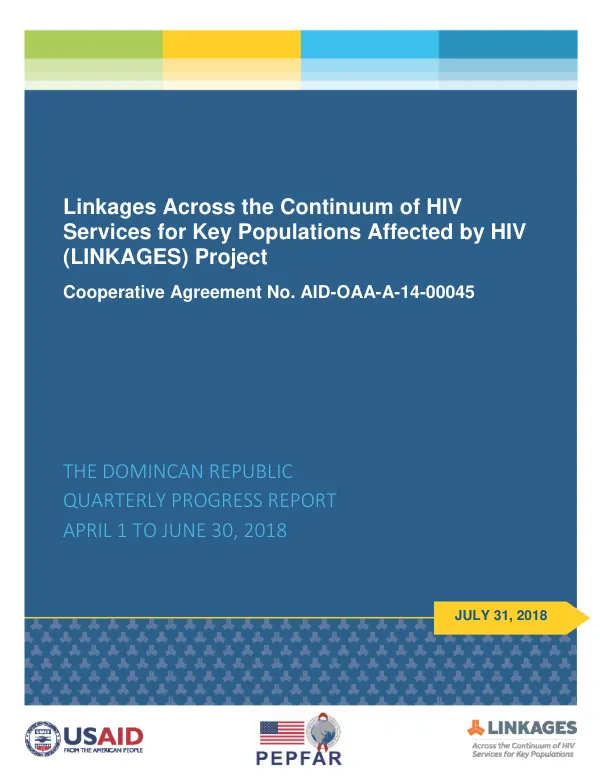
LINKAGES Quarterly Report (April 1 – June 30, 2018) – The Dominican Republic
The LINKAGES project in the Dominican Republic continued to provide technical support in the areas of voluntary partner referral (VPR), gender-based violence (GBV), and strategic outreach and peer navigation during the quarter of April 1 to June 30, 2018.
2018 · 13 pages
Sign in to readA free account is required to download.
Abstract
In the area of VPR, the project scaled up the initiative and provided enhanced support to clinics with implementation challenges. A total of 945 index patients were offered VPR across the 10 participating clinics, with 454 determined eligible and 394 accepting participation in VPR. Participating index patients referred 422 partners, with 180 coming in for HIV testing and 52 newly diagnosed with HIV, representing a case-finding rate of 29%. In the area of GBV, the project continued to advance in both Puerto Plata and La Romana, with strategies identified for accelerated progress in Santo Domingo and Santiago. In Puerto Plata, 563 people disclosed violence and were referred to HIV testing services by CEPROSH, with 9 of them testing positive. In La Romana, Clinica la Familia identified 34 individuals who experienced violence in Q3. The project also initiated a strategic information (SI) assessment to determine loss to follow-up (LTFU) factors and contribute to adherence and retention strengthening. The Global Fund (GF) Technical Assistance (TA) continued to support the four community service organizations (CSOs) in implementing adapted strategic outreach and peer navigation strategies. The CSOs reported new HIV positive cases identified and navigated through these strategies. The project also continued to communicate with the Global Fund Principal Recipient CONAVIHSIDA to share progress on the strategies to date and offer adapted materials. The SI assessment aimed to identify factors associated with loss to follow-up of people living with HIV in the Dominican Republic, with the goal of providing recommendations to improve adherence. The project began gathering information to help identify these factors, with the anticipated product being a user-friendly guide for healthcare professionals to be used as a job aid for adherence counseling. The VPR cascade continued to show improvement, with an increase in the number of index patients approached for VPR and a consistent level of eligibility. However, the drop between approached and eligible continued to be the biggest gap in the VPR cascade. Participating index patients referred 422 partners, with 180 coming in for HIV testing and 52 newly diagnosed with HIV, representing a case-finding rate of 29%. The project identified the need to strengthen acceptability of VPR, particularly through improving how index patients communicate with and promote testing to their partners. The modality of VPR showed a preference for passive referral, with 90% of clients selecting this modality. The project suggested focusing training efforts on passive referral and dedicating less time to the other modalities. The VPR cascade also showed that 75% of index patients who were approached were already in care and 25% were newly diagnosed, which is consistent with previous findings.
Related documents