MINISTRY OF HEALTH
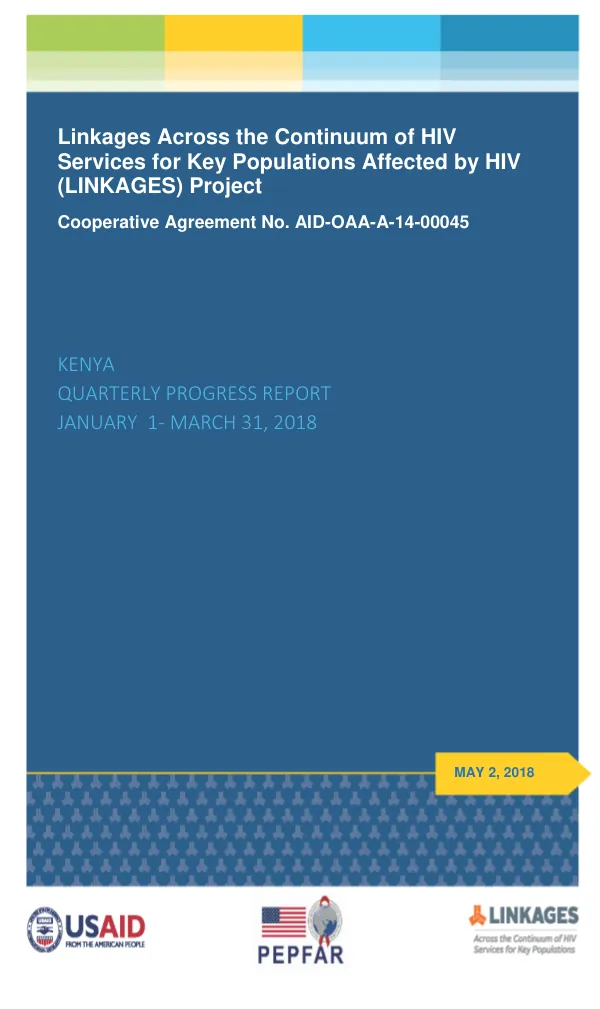
LINKAGES Quarterly Report (January 1 – March 31, 2018) - Kenya
The LINKAGES project in Kenya continued to provide comprehensive care and treatment services for female sex workers (FSWs) and men who have sex with men (MSM) through hot spot-based outreach, drop-in centers (DICs), and one-on-one outreach led by peer educators.
2018 · 16 pages
Sign in to readA free account is required to download.
Abstract
Emphasis was placed on ensuring that targeted outreaches were focused on hot spots and on the peers of peer educators who had not received clinical services. Implementation partners, including Health Options for Young Men on HIV/AIDS/STI (HOYMAS), Men Against AIDS Youth Group (MAAYGO), National Organization of Peer Educators (NOPE), and Keeping Alive Societies Hope (KASH), continued to implement partner notification services to increase targeted testing and identification of MSM and male sex workers (MSWs) living with HIV. LINKAGES participated in the nationwide exercise for key population (KP) size estimates and hot spot validation, with all partners completing the activity and submitting their results online to the National AIDS and STI Control Program (NASCOP). The project piloted the key population virtual currency approach of motivating, recognizing, and rewarding high-performing peer educators. As a result, high-performing KASH peer educators went on an exchange visit to the International Centre for Reproductive Health (ICRH-K) in Mombasa. Strengthening of the strategic information system was a key activity in Q2, with the training and rollout of eCascade to all 18 IPs, training on new monitoring and evaluation (M&E) tools, and training on revised reporting requirements. During the reporting period, LINKAGES IPs provided HIV testing services (HTS) to 13,236 FSWs and 1,969 MSM for the first time in FY18. An additional 4,434 FSWs and 1,921 MSM received a re-test during Q2. HTS was delivered at DICs and through mobile integrated outreaches, with a total of 497 outreaches conducted. Data analysis was done to prioritize the hot spots with high volumes and low testing rates since the beginning of the fiscal year. The program aims to test all eligible FSWs and MSM, and the gap of those not tested is attributed to either those tested by other programs within the last three months or those who were referred but have not visited the DIC for clinical services. Outreach planning meetings were conducted using data compiled in Q1, feedback received from the peers at the hot spots, and from support supervision. The meetings focused on making HTS accessible to FSWs to ensure the HTS targets for FY18 were met through hot spot outreaches, DIC extended hours, and door-to-door for home-based FSWs. Extended DIC hours were piloted at NOPE Kikuyu DIC, with late night extended operating hours on selected days for the convenience of KP individuals whose hot spots are located nearby. This strategy was piloted after it was noted that many KP members within the town were not accessing services at the DIC even though it was located near the hot spots. Hours were extended to 10 p.m. on at least two days a month. Biomedical and paralegal services were provided as usual during the extended hours. The project engaged 825 peer educators (587 FSWs and 238 MSM) who were active during Q2 and submitted their reports; and 64 peer ART champions (59 FSWs and 5 MSM). All LINKAGES sub-grantees were engaged in the national key population size estimation exercise. One Family AIDS Initiative Response (FAIR) clinician attended a differentiated service delivery workshop in South Africa, organized by the International AIDS Society (IAS).