MERCY CORPS INTERNATIONAL
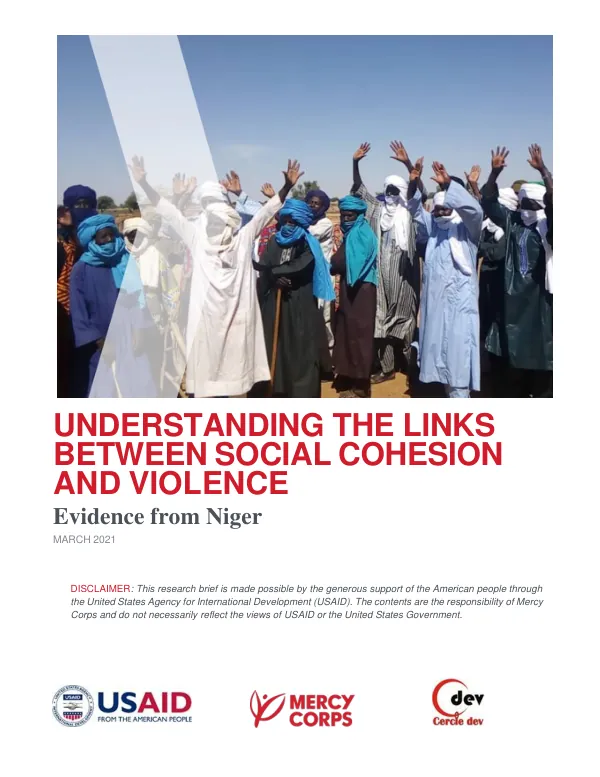
Links between Social Cohesion and Violence: Evidence from Niger
Social cohesion is a critical component in preventing and mitigating violent conflict.
2021 · 11 pages
Sign in to readA free account is required to download.
Abstract
In Niger, a country plagued by violent extremism, social cohesion has become a cornerstone of peacebuilding efforts. The Tillabéri region, where Mercy Corps' USAID-funded Preventing Violent Extremism Actions through increased social cohesion Efforts (PEACE) program is being implemented, has suffered from increasing violent conflict driven by socio-economic crisis, climate shocks, and the spillover of armed group activity from neighboring Mali. Research has shown that only some dimensions of social cohesion are associated with a propensity towards violence. Specifically, a lack of trust, particularly around the sharing and management of natural resources, is linked to support for the use of violence. On the other hand, positive inter-group interactions are associated with reduced support for violence. Furthermore, both vertical (state-society) and horizontal (inter-community) cohesion are linked to reduced support for violence. The PEACE program seeks to strengthen social cohesion along ethnic, citizen-government, and inter-generational lines through community-driven development (CDD) approach. The program's theory of change posits that if communities are fully involved in the assessments, design, and implementation of community projects, and the community projects work to bring diverse communities together to strengthen trust, improve social interactions, facilitate cooperation, and support tolerance, then community resilience to violent extremism will improve. The program's baseline survey collected data on several dimensions of social cohesion, including trust, tolerance, inclusion, cooperation, interactions between ethnic groups, and collective action. The survey also asked whether respondents thought violence is sometimes necessary to defend a social or political cause. Due to the risks and sensitivities of asking people about violent extremism, support for violence was used as a proxy measure. The analysis of the survey results, controlling for respondent demographics, found that only positive inter-group interactions are linked to reduced support for violence. Furthermore, aspects of both vertical and horizontal cohesion are linked to reduced support for violence. The findings suggest that peacebuilding programs should emphasize trust-building around the central issues driving social tensions, prioritize the quality of interactions between communities, and focus on improving government-society relations in addition to inter-group relations. The PEACE program's theory of change assumes that a lack of horizontal and vertical cohesion is a key driver of support for violence. The baseline data provides evidence to support this assumption, highlighting the importance of strengthening social cohesion in preventing and mitigating violent conflict. The program's community-driven development approach has the potential to improve community resilience to violent extremism by bringing diverse communities together to strengthen trust, improve social interactions, facilitate cooperation, and support tolerance.
Related documents
Documents in this collection
 2021
2021USAID DEC
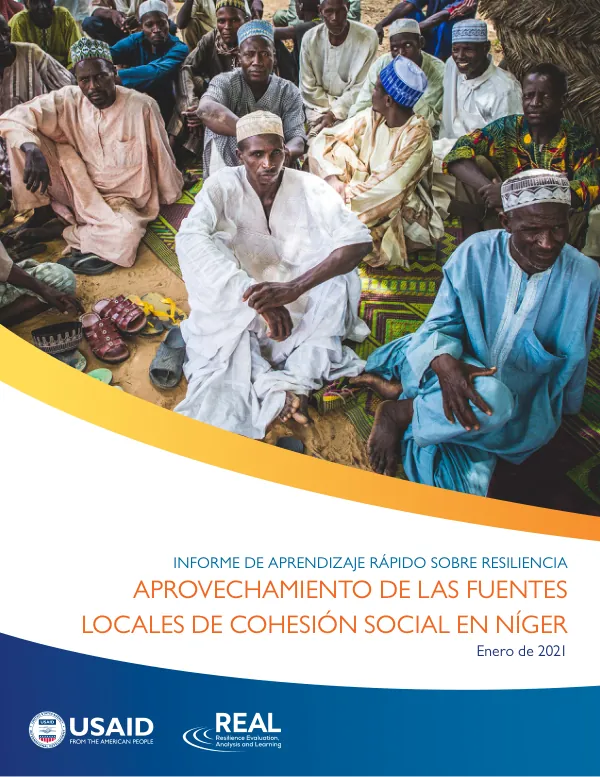
Harnessing Local Sources of Social Cohesion in Niger: Lessons for Building Resilience in Protracted Crises and Conflict-affected Settings
Open record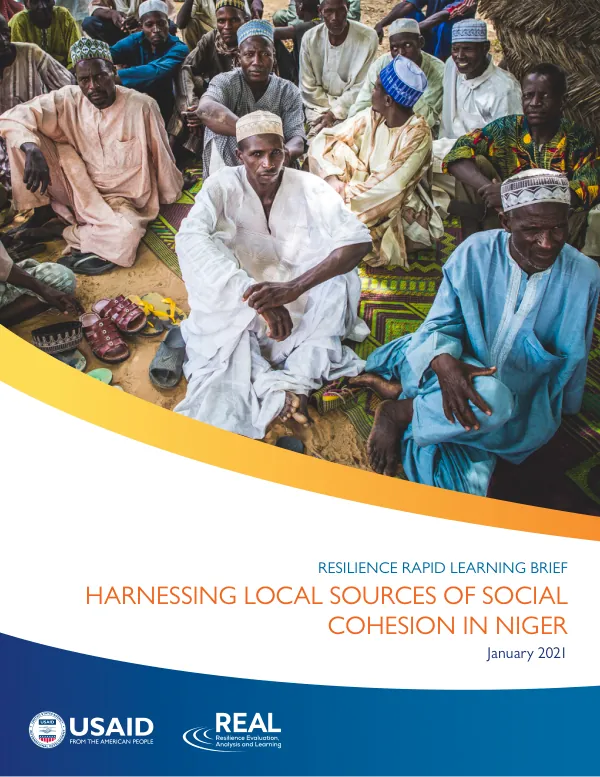 2021
2021USAID DEC