USAID DEC
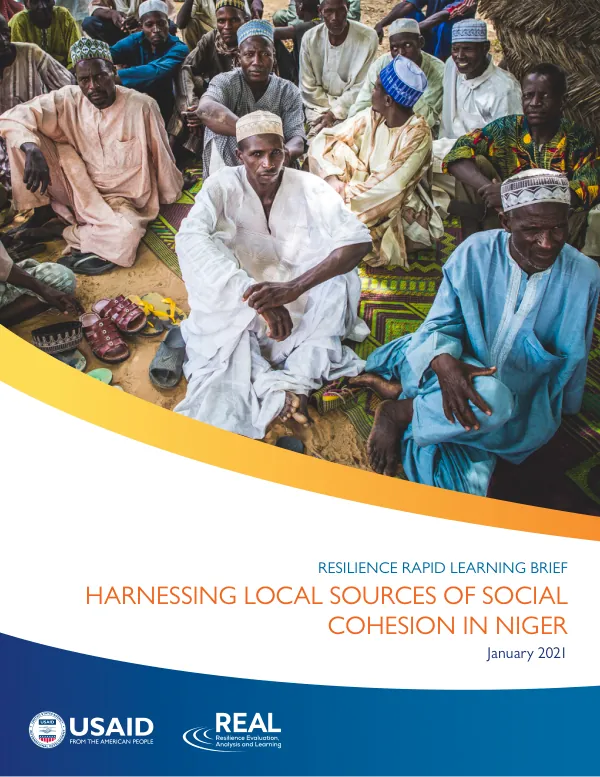
Harnessing Local Sources of Social Cohesion in Niger: Lessons for Building Resilience in Protracted Crises and Conflict-affected Settings
Sign inFOOD FOR THE HUNGRY, INTERNATIONAL
Harnessing Local Sources of Social Cohesion in Niger: Lessons for Building Resilience in Protracted Crises and Conflict-affected Settings
Social cohesion is a critical component in building resilience and improving long-term well-being outcomes, particularly in areas prone to ongoing conflicts, natural disasters, and other shocks and stresses.
2021 · 16 pages
Sign in to readA free account is required to download.
Abstract
In Niger, the Tillabéri region is a prime example of a setting where social cohesion plays a vital role in strengthening community and household resilience to risks such as flooding and conflict. Research has demonstrated that social capital contributes to resilience by enabling households to rely on individuals within their network during times of hardship and facilitating local collective action to address shared challenges. Bridging social capital between groups is also an important factor for building intergroup social cohesion, which can strengthen household and community resilience to risks. In Niger, pastoralist and agropastoralist households can more effectively navigate access to resources even in the face of economic and environmental shocks, thereby strengthening resilience in communities. However, there are still major gaps in theory and evidence on the mechanisms behind local-level variation in social cohesion. In particular, there is relatively little existing evidence about how local social and political factors shape different aspects of social cohesion, including trust, collective action norms, and the nature of perceptions about and behaviors toward other groups. Without understanding how local social structures and institutional quality shape specific aspects of social cohesion, programming interventions may misdiagnose underlying problems and can miss opportunities to develop creative and contextually grounded interventions. A baseline survey conducted in the Tillabéri region of Niger as part of the USAID's Preventing violent Extremism Actions through increased social Cohesion Efforts (PEACE) program provides valuable insights into the factors that contribute to local-level variation in social cohesion. The survey measures six dimensions of social cohesion: trust, tolerance, inclusion, cooperation, interactions between groups, and collective action. Additionally, the survey analyzes contextual factors such as governance, the participation of women and youth in conflict management and peacebuilding, and patterns of peace and security within the community. Key findings from the survey provide examples of both strong and weak dimensions of social cohesion and demonstrate the variations in these relationships across villages. For instance, higher levels of collective action and collaboration with other groups do not necessarily increase intergroup trust, but positive interactions do. The relative strength of different components of social cohesion varies considerably across villages, and some dimensions of social cohesion differ by gender, but not by age. There is no clear relationship between trust in leaders and social cohesion, and higher levels of access to public services are associated with increases in social inclusion. Conflict management mechanisms can help facilitate inclusion, but they may not contribute to other dimensions of social cohesion. These findings highlight the importance of understanding the complex relationships between social cohesion and other factors in order to develop effective programming interventions. To increase social cohesion in support of strengthening long-term peace and resilience outcomes, development and humanitarian programs can employ several strategies. These include carefully designing and leveraging an inclusive, participatory process to identify, design, and implement joint projects to model and reinforce social cohesion. Creating flexibility to tailor specific activities to the realities of individual villages is also essential, as is supporting positive interactions across groups to build trust and tolerance. Promoting the inclusion of women to contribute to better outcomes is also critical, as is layering intergroup contact and other activities onto governance-strengthening activities. Pairing efforts to strengthen inclusive and legitimate conflict management mechanisms with other approaches can also help to facilitate social cohesion. Overall, harnessing local sources of social cohesion in Niger is critical for building resilience in protracted crises and conflict-affected settings. By understanding the complex relationships between social cohesion and other factors, development and humanitarian programs can develop effective programming interventions that support the strengthening of long-term peace and resilience outcomes.