FLORIDA INTERNATIONAL UNIVERSITY
LIVELY Newsletter #7: Future systems and new projects
Livestock Systems Innovation Lab researchers are exploring various projects to improve livestock production and consumption in West Africa.
2019 · 12 pages
Sign in to readA free account is required to download.
Abstract
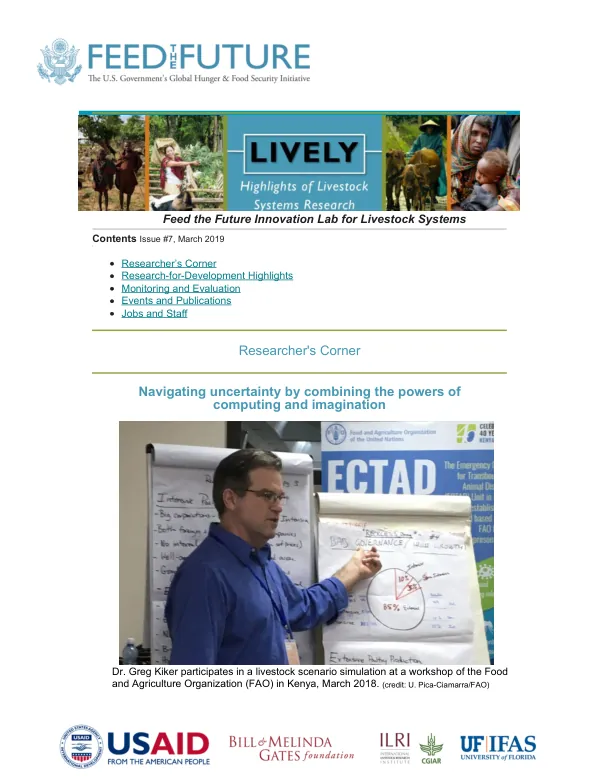
Dr. Greg Kiker, a professor of agricultural and biological engineering at the University of Florida, leads the Lab's area of inquiry, "Future Livestock Systems." Kiker's research combines the power of data with the power of storytelling to provide mental maps for thinking through life's complexities. He uses scenarios to reveal potential future conditions, enabling leaders to prepare for the best, worst, and in-betweens. The Lab works on three main strands of future livestock systems research: scenario workshops, network modeling, and household modeling. Kiker led the first scenario workshop in Ethiopia in 2018 and is planning two more workshops in Rwanda and Burkina Faso this year. Participants are guided to keep asking "what if" until they have created multiple potential storylines. Students appreciate Kiker's distinct skill set, citing his expertise and experience in biological systems modeling as unparalleled in the field. In Burkina Faso, a new research project aims to improve the feeding of guinea fowl and the production of keets (chicks). The project, led by Dr. William S. Kisaalita from the University of Georgia, seeks to increase the productivity per guinea fowl hen from 5 to 50 marketable birds per year. The research involves optimizing the level of fly larva in the feed to supply much-needed protein and synchronizing egg hatching based on methods used successfully in Uganda's Rakai district. Another project in Burkina Faso focuses on milk safety, led by Dr. Silvia Alonso from the International Livestock Research Institute. The study tracks the presence of aflatoxin in the milk supply chain and works on making the milk safer. Activities include mapping local dairy value chains, measuring aflatoxin and other pathogens in milk, assessing aflatoxin in cattle feed, and estimating health risks for children, women, and other milk consumers. In West Africa, a comprehensive project aims to strengthen the region's livestock systems by providing accessible, affordable feed and improved animal health services for sheep and goats. The project, led by Dr. Salissou Issa from Niger's National Institute for Agricultural Research, involves Mercy Corps staff and five scientists from Texas A&M University and the University of Niger. The project has gathered baseline data in both countries and purchased laboratory equipment for the National Institute for Agricultural Research and the Environment and Agricultural Research Institute. The Livestock Systems Innovation Lab follows a three-step evaluation method for every project: Innovation Evaluation, Dissemination Studies, and Impact Evaluation. This evaluation process allows the Lab to determine short-, mid-, and long-term changes arising from the adoption of innovations and the sustainability of innovations.