MANAGEMENT SCIENCES FOR HEALTH
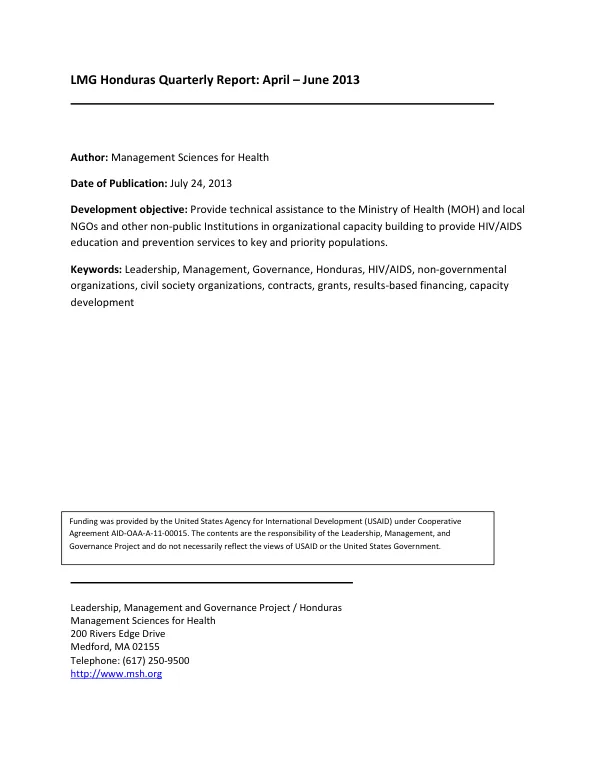
LMG Honduras Quarterly Report: April – June 2013
The Leadership, Management, and Governance (LMG) program in Honduras provided technical assistance to the Ministry of Health (MOH) and local non-governmental organizations (NGOs) to improve organizational capacity building for HIV/AIDS education and prevention services to key and priority populations.
2013 · 14 pages
Sign in to readA free account is required to download.
Abstract
The program aimed to provide quality, usage, and financing of critical health services, particularly HIV/AIDS services, to underserved populations. Honduras has a lower middle-income status with improvements in certain health and economic indicators, but still struggles with social inequalities and low health rates. The country has a disproportionately high HIV prevalence rate, particularly among key populations such as MSM, Garífuna, and sex workers. The Government of Honduras has invested in capacity building in the health sector, resulting in improvements in certain health indicators. The LMG program provided technical assistance to the MOH to contract local NGOs to provide preventive and educative services for key populations. The program also assisted nine local NGOs to improve the quality of their technical and financial proposals. Six local NGOs were contracted, and the LMG/Honduras office was established in Tegucigalpa. The team members were onboarded, and the PY 1 work plan was approved. The program focused on improving health conditions among key populations by enhancing quality, usage, and financing of critical health services. This included prevention and HIV testing services organized and delivered at the community level. Community participation was emphasized as a critical factor in improving health status at the community level. The Government of Honduras' Response to HIV/AIDS involved various steps taken over the past decade. The current HIV/AIDS National Strategic Plan (PENSIDA III) prioritized scale-up of prevention efforts for MSM, Garífuna, sex workers, and pregnant women. The Sula Valley, North Coast, and Tegucigalpa metropolitan area were identified as geographical focus areas due to their higher prevalence rates. The GOH has started drafting PENSIDA IV, anticipated to be finalized in 2013, under the umbrella of the National HIV Strategy. The LMG program collaborated with the MOH and local NGOs to improve health services for key populations. The program's achievements included providing technical assistance to the MOH and local NGOs, contracting six local NGOs, and establishing the LMG/Honduras office. The program's focus on community participation and quality health services aimed to improve health conditions among key populations. The LMG program's activities were guided by the National HIV Strategy, which formulated a strategic vision for comprehensive HIV and AIDS promotion, prevention, care, and support services within the National Health Sector Reform framework. The program's efforts were aligned with the MOH's decentralization of health services, with the establishment of the UECF and UGD units. The LMG program's quarterly report for April-June 2013 highlighted the program's achievements and outstanding issues. The report provided an update on project accomplishments and informed USAID/Honduras of any outstanding issues during this period. The report served as a tool for monitoring and evaluation, highlighting the program's progress and challenges. The LMG program's focus on improving health services for key populations was critical in addressing the country's HIV epidemic. The program's efforts aimed to enhance quality, usage, and financing of critical health services, particularly HIV/AIDS services, to underserved populations. The program's collaboration with the MOH and local NGOs was essential in achieving its objectives and improving health conditions among key populations.
Related documents