MANAGEMENT SCIENCES FOR HEALTH
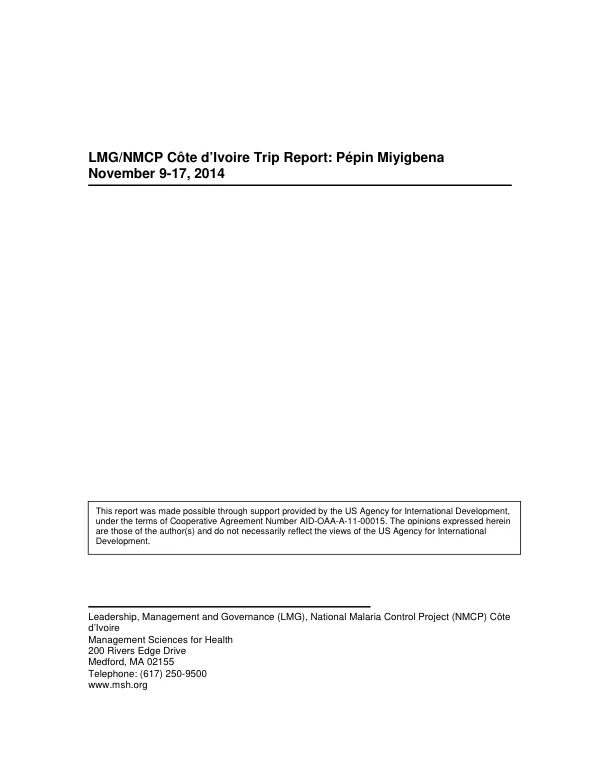
LMG/NMCP Côte d’Ivoire Trip Report: Pépin Miyigbena
The Leadership, Management and Governance (LMG) National Malaria Control Program (NMCP) Côte d'Ivoire trip report highlights the activities and accomplishments of the program from November 9-17, 2014.
2014 · 11 pages
Sign in to readA free account is required to download.
Abstract
The trip report emphasizes the importance of building the capacity of local NMCPs to effectively implement national malaria strategies. The program's two-year goal is to build the capacity of the local NMCPs to effectively implement national malaria strategies. The LMG/NMCP project provides direct technical assistance to a minimum of six, and up to eight, target country NMCPs. The project has three main objectives: to effectively manage National Malaria Control Program human, financial, and material resources; to develop and direct policy for the implementation and surveillance of the national malaria strategy; and to mobilize stakeholders to participate in malaria control coordination and implementation efforts. LMG/NMCP staff have developed country-specific workplans based on the results of an initial rapid capacity assessment conducted with NMCP and stakeholder participation. The program also provides targeted training and coaching to NMCPs on the implementation of Global Fund grant design. The trip report highlights the importance of the Leadership Development Program Plus (LDP+), which is a performance improvement process that empowers teams to use a leading and managing for results model. The LDP+ includes an inspiring shared vision, leading and managing practices, a measurable results process, and aligning stakeholders around a common challenge. During the trip, Senior Technical Advisors from each of the five initial countries (Burundi, Cameroon, Côte d'Ivoire, Liberia, and Sierra Leone) presented on their progress and challenges in the fight against malaria. The presentations showed that many of the completed activities by NMCPs in each country were made possible by LMG/NMCP support and the work of Senior Technical Advisors. The trip report also highlights the use of project evaluation tools, such as the Organizational Capacity Assessment Tool (OCAT) and the Program for Organizational, Resilience, and Resilience (PROGRES tool). The OCAT provides a snapshot of the initial organizational situation and allows the project to measure progress achieved through implementation of priority actions. The trip report emphasizes the importance of adapting the OCAT to take into account all important aspects of management at the central coordination. A modified version of the OCAT will be available for use in Burundi. The program also focuses on using different Google applications in order to improve coordination and planning. Each participant received one-on-one assistance to use the various Google features. The program also uses LeaderNet and OLLIE (MSH intranet) platforms to strengthen communication and online training. The trip report highlights the importance of communication and writing skills, particularly in developing reports and success stories. The program emphasizes the need for data harmonization and data collection to document achievements. The trip report concludes that the LMG/NMCP project has made significant progress in building the capacity of local NMCPs to effectively implement national malaria strategies. The program has provided direct technical assistance to NMCPs and has adapted the OCAT to take into account all important aspects of management at the central coordination. The program has also used different Google applications to improve coordination and planning. The trip report highlights the importance of sustainability and the need for Senior Technical Advisors to transfer responsibilities to NMCP staff. The program emphasizes the need for data harmonization and data collection to document achievements. The trip report concludes that the LMG/NMCP project has made significant progress in building the capacity of local NMCPs to effectively implement national malaria strategies.
Related documents