USAID DEC
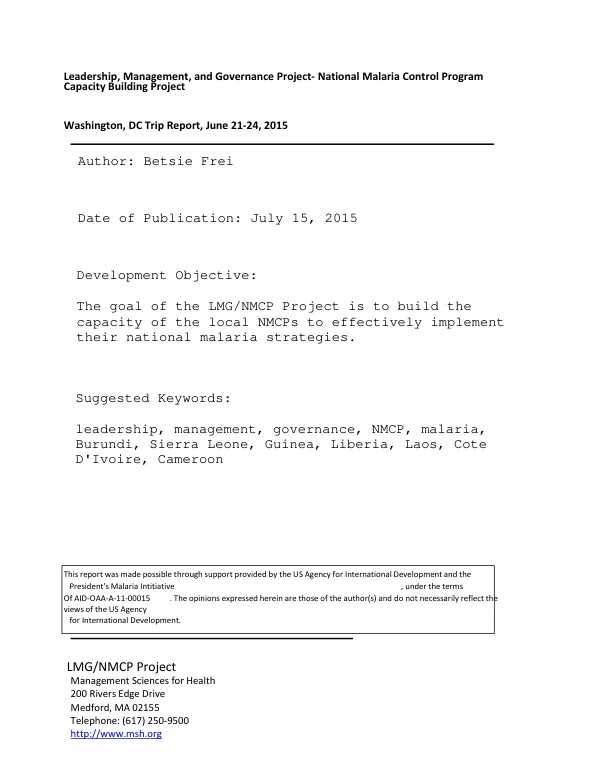
Leadership, Management, and Governance Project- National Malaria Control Program Capacity Building Project
Sign inMANAGEMENT SCIENCES FOR HEALTH
Leadership, Management, and Governance Project- National Malaria Control Program Capacity Building Project
The Leadership, Management, and Governance Project-National Malaria Control Program Capacity Building Project aimed to build the capacity of local National Malaria Control Programs (NMCPs) to effectively implement their national malaria strategies.
2015 · 18 pages
Sign in to readA free account is required to download.
Abstract
The project was funded by the US Agency for International Development and the President's Malaria Initiative. The project's goal was to provide long-term technical assistance (LTTA) to NMCPs in several countries, including Burundi, Sierra Leone, Guinea, Liberia, Laos, Cote d'Ivoire, and Cameroon. The project's Senior Project Officer (SPO) was responsible for coordinating monitoring, evaluation, reporting, and communication across various mechanisms receiving funding from the President's Malaria Initiative. In June 2015, the SPO, Betsie Frei, traveled to Arlington, Virginia, to plan monitoring, evaluation, and reporting for the LTTA. During the trip, Frei met with key LMG staff, including the LMG/NMCP Principal Technical Advisor, Emmanuel Le Perru, and the M&E Senior Technical Advisor, Monita Baba Djara. They discussed different approaches to providing coordination and evaluation support to the NMCPs. The team identified several key questions that needed to be clarified, including the primary question that the President's Malaria Initiative would like the assistance to answer. They assumed that the answer was "What is the value added of long-term technical assistance?" but needed to confirm this with PMI. The team also discussed possible deliverables, including a summary report of all NMCP baseline assessments, identifying shared outcome indicators for all LTTA, and conducting key informant interviews. Frei also met with Bhavna Patel, the USAID/PMI Activity Manager, to discuss the coordination and evaluation work. Patel confirmed that the key question the SPO should be trying to answer was "What is the added value of long-term technical assistance to NMCPs?" The team agreed to compile each mechanism's quarterly reports into a summary report and to expand quarterly coordination calls to include other malaria partners. The next steps for the project included drafting an agenda for the next quarterly call, agreeing on a theory of change for long-term technical assistance, creating a results framework, and identifying a variety of deliverables. The project also planned to hold an annual coordination meeting with all LTTA advisors in attendance, likely in Abidjan, Côte d'Ivoire, in November. The project's key activities included coordinating quarterly calls with PMI, compiling quarterly reports, and identifying shared outcome indicators for all LTTA. The project also planned to conduct key informant interviews and develop a concept paper on PMI's LTTA strategy. The project's next steps included drafting an agenda for the next quarterly call, agreeing on a theory of change for long-term technical assistance, and creating a results framework.
Related documents