USAID DEC
Long-acting Reversible Contraception (LARC) Poster Series
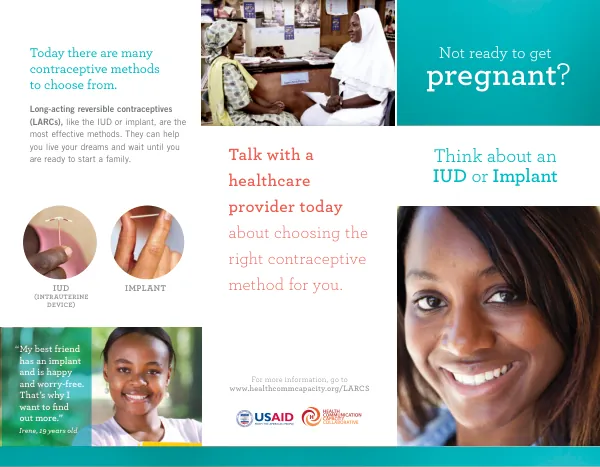
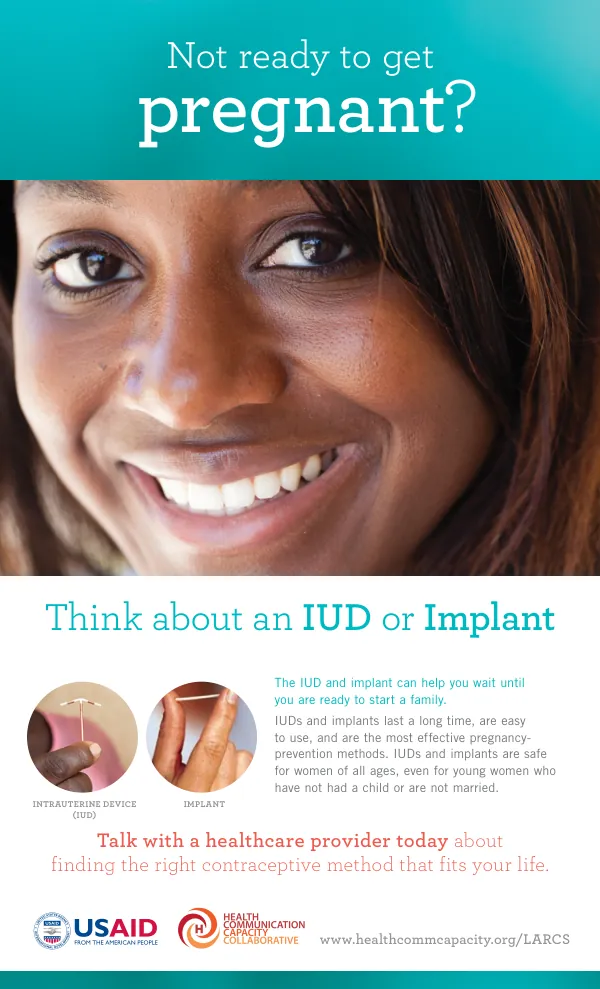
Long-acting reversible contraception, such as the intrauterine device (IUD) and implant, can help women delay starting a family until they are ready.
7 pages
Sign in to readA free account is required to download.
Abstract
These methods are highly effective in preventing pregnancy, lasting for a long time and requiring minimal user effort. IUDs and implants are safe for women of all ages, including young women who have not had a child or are not married. The IUD is a small, T-shaped device inserted into the uterus by a trained healthcare provider. It is a private and easy-to-use method of contraception, as it cannot be seen or felt once inserted. The IUD provides long-acting protection against pregnancy and can be removed when a woman is ready to become pregnant. IUDs are available in various types, including hormonal and non-hormonal options. The implant is a small, flexible rod inserted under the skin of the upper arm by a trained healthcare provider. It is a safe and effective method of contraception, suitable for women of all ages. The implant releases hormones that prevent ovulation, making it a highly effective form of birth control. It can be removed when a woman is ready to become pregnant, and its effects are reversible. Long-acting reversible contraception, such as the IUD and implant, can help women achieve their goals and live the life they plan. By preventing unintended pregnancies, these methods enable women to focus on their education, career, and personal development. They also provide women with the freedom to make informed decisions about their reproductive health and family planning. In addition to their individual benefits, IUDs and implants can also be used in conjunction with other forms of birth control to provide even greater protection against pregnancy. Women who are planning their future together can discuss the birth spacing method that is right for them with a healthcare provider. IUDs and implants are the most effective methods of birth control, and they are safe for women of all ages, including those who have not yet had a child.