USAID DEC
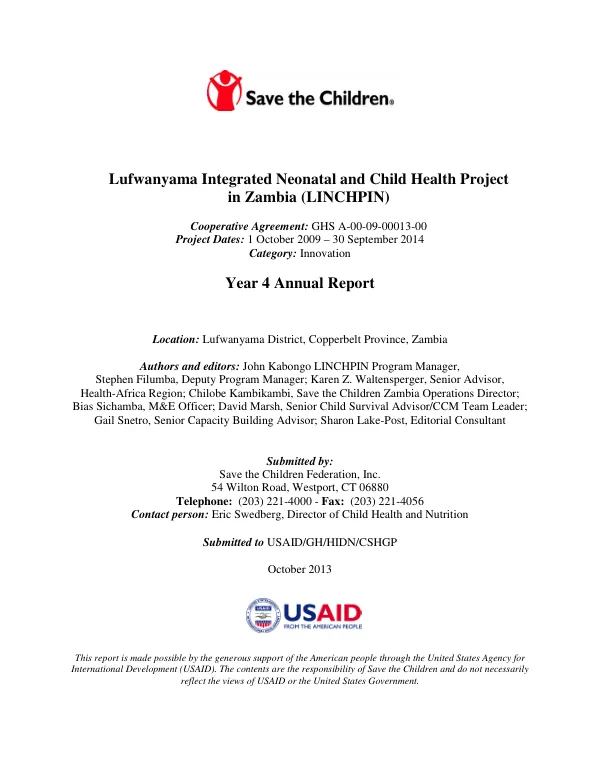
Lufwanyama Integrated Neonatal and Child Health Project in Zambia (LINCHPIN) Year 4 Annual Report
Sign inMINISTRY OF HEALTH
Lufwanyama Integrated Neonatal and Child Health Project in Zambia (LINCHPIN) Year 4 Annual Report
The Lufwanyama Integrated Neonatal and Child Health Project in Zambia (LINCHPIN) is a five-year initiative aimed at reducing under-5 mortality and advancing Zambia's efforts to meet Millennium Development Goal 4.
2013 · 51 pages
Sign in to readA free account is required to download.
Abstract
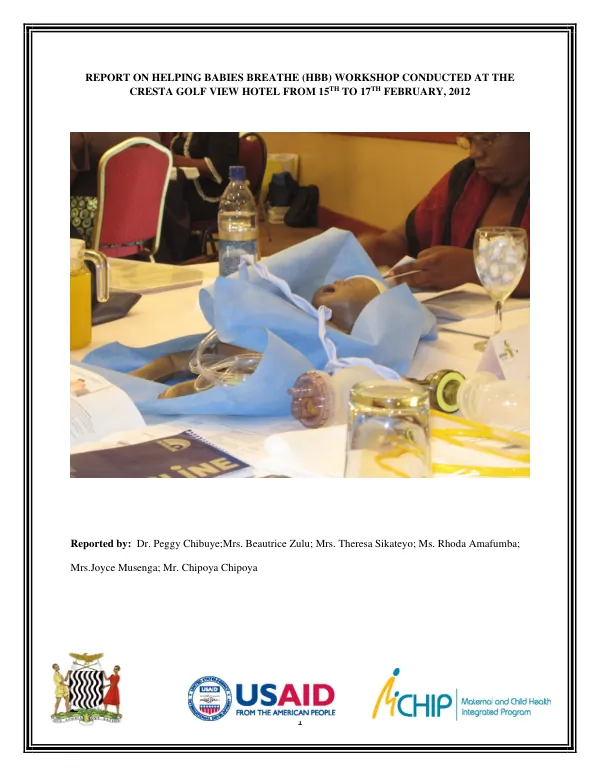
The project, implemented by Save the Children in partnership with the Lufwanyama District Health Management Team, focuses on an integrated, community-based newborn care and community case management package. This package is delivered through an enhanced district-wide community health program linked to health facilities and Neighborhood Health Committees. The project's interventions include Maternal and Newborn Care at 40 percent, Pneumonia Case Management at 20 percent, Prevention and Treatment of Malaria at 20 percent, and Control of Diarrheal Disease at 20 percent. The project has a strategic objective to increase the use of curative interventions, with four intermediate results: Increased access to and availability of services, Improved quality of services, Increased demand for services and health practices, and Enabled environment. In Year 4, LINCHPIN continued to consolidate its programmatic achievements, leveraging other funds and applying match to meet outstanding district needs. The project also worked to engage local private businesses, including those in the mining sector, to support health-related community initiatives. Additionally, Save the Children launched a new nutrition program funded by the Swedish Postcode Lottery and became a member of the Scaling-up Nutrition in Zambia Task Force. One of the main accomplishments of LINCHPIN in Year 4 was the training of health workers. Twenty-four health workers were trained to manage sick children, care for newborns, and make referrals. These health workers supervise 62 active Community Health Workers in Integrated Community Case Management and support 103 trained Traditional Birth Attendants, including 47 CHW-TBA teams. Save the Children also trained 12 health workers and 70 Traditional Birth Attendants in essential newborn care, including Helping Babies Breathe, a national approach to increase availability of resuscitation to manage newborn birth asphyxia in low-resource settings. Another key accomplishment was the training of Safe Motherhood Action Groups (SMAGs). LINCHPIN trained 63 SMAG members to facilitate formation of SMAGs in their respective communities. SMAGs are supervised by health facilities and Community Health Workers and are an important link between facility and community. LINCHPIN used the updated national MAMA-SMAG curriculum for this training. In response to high CHW attrition, Save the Children trained an additional 16 Community Health Workers for certification by the district. The new CHWs were selected with community involvement from the neediest areas, bringing the total number of CHWs back up to 78. The revised CHW curriculum now includes an iCCM module in addition to the basic preventive and promotion package of activities. Before deployment, LINCHPIN provided the new CHWs with bicycles, bags, registers, and mid-upper arm circumference (MUAC) tapes. The project's training programs have contributed to LINCHPIN's goal of reducing under-5 mortality. The trained health workers, Community Health Workers, and Traditional Birth Attendants are equipped to provide essential newborn care and community case management services, improving access to and availability of services, quality of services, demand for services and health practices, and the enabled environment.