MINISTRY OF HEALTH
USAID ETB Project Success Story: GeneXpert Redistribtion in Copperbelt Province
The USAID Eradicate TB project provided support to the Ministry of Health in Copperbelt Province to improve management of TB laboratory commodities.
2017 · 2 pages
Sign in to readA free account is required to download.
Abstract
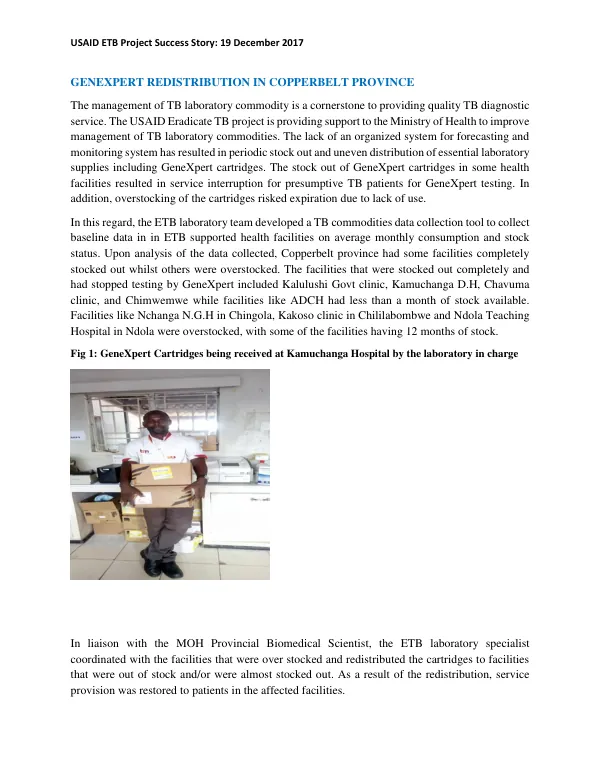
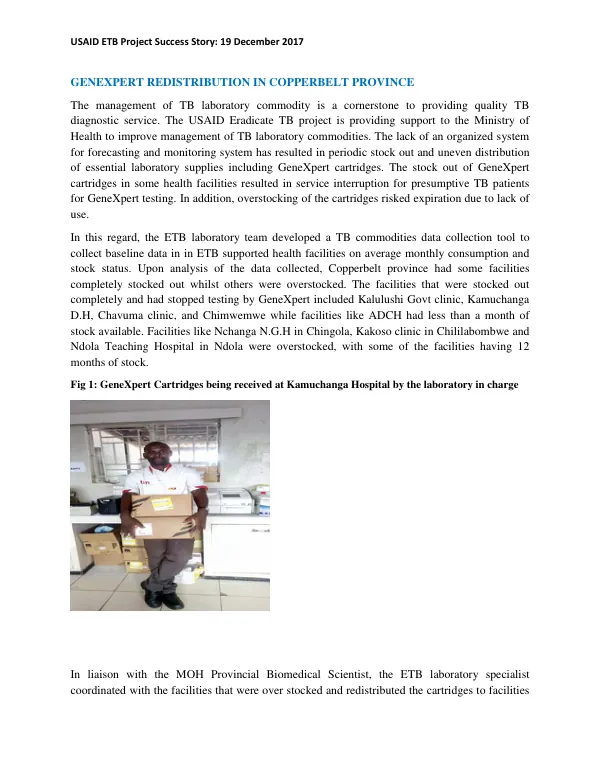
A key challenge was the lack of an organized system for forecasting and monitoring, resulting in periodic stockouts and uneven distribution of essential laboratory supplies, including GeneXpert cartridges. Stockouts of GeneXpert cartridges in some health facilities interrupted service for presumptive TB patients undergoing GeneXpert testing, while overstocking risked expiration due to lack of use. To address this issue, the ETB laboratory team developed a TB commodities data collection tool to gather baseline data on average monthly consumption and stock status in ETB-supported health facilities. Analysis of the collected data revealed that Copperbelt Province had facilities that were completely stocked out, while others were overstocked. Facilities that were completely stocked out and had stopped testing by GeneXpert included Kalulushi Govt clinic, Kamuchanga D.H, Chavuma clinic, and Chimwemwe, while facilities like ADCH had less than a month of stock available. Conversely, facilities like Nchanga N.G.H in Chingola, Kakoso clinic in Chililabombwe, and Ndola Teaching Hospital in Ndola were overstocked, with some facilities having 12 months of stock. In collaboration with the MOH Provincial Biomedical Scientist, the ETB laboratory specialist coordinated with facilities that were overstocked to redistribute the cartridges to facilities that were out of stock or almost stocked out. As a result of the redistribution, service provision was restored to patients in the affected facilities. The success of this initiative highlights the importance of effective management of TB laboratory commodities in ensuring timely and quality diagnostic services for presumptive TB patients. The ETB laboratory team's data collection and analysis efforts provided valuable insights into the stock status and consumption patterns of GeneXpert cartridges in Copperbelt Province. This information enabled targeted interventions to address stockouts and overstocking, ultimately improving the availability of essential laboratory supplies and ensuring uninterrupted service provision for TB patients. The project's success demonstrates the potential of collaborative efforts between the Ministry of Health and development partners to improve TB laboratory management and diagnostic services. The redistribution of GeneXpert cartridges in Copperbelt Province serves as a model for effective TB laboratory commodity management. By leveraging data-driven insights and collaborative efforts, the project was able to restore service provision to affected facilities and improve the overall quality of TB diagnostic services in the region. This achievement underscores the importance of investing in robust laboratory management systems to ensure timely and accurate diagnosis of TB, ultimately contributing to improved health outcomes for patients.