USAID DEC
Report on Helping Babies Breathe (HBB) Workshop Conducted at the Cresta Golf View Hotel from 15th to 17th February, 2012
Sign inMCHIP
Report on Helping Babies Breathe (HBB) Workshop Conducted at the Cresta Golf View Hotel from 15th to 17th February, 2012
The Helping Babies Breathe (HBB) workshop was conducted at the Cresta Golf View Hotel in Lusaka from February 15th to 17th, 2012.
2012 · 8 pages
Sign in to readA free account is required to download.
Abstract
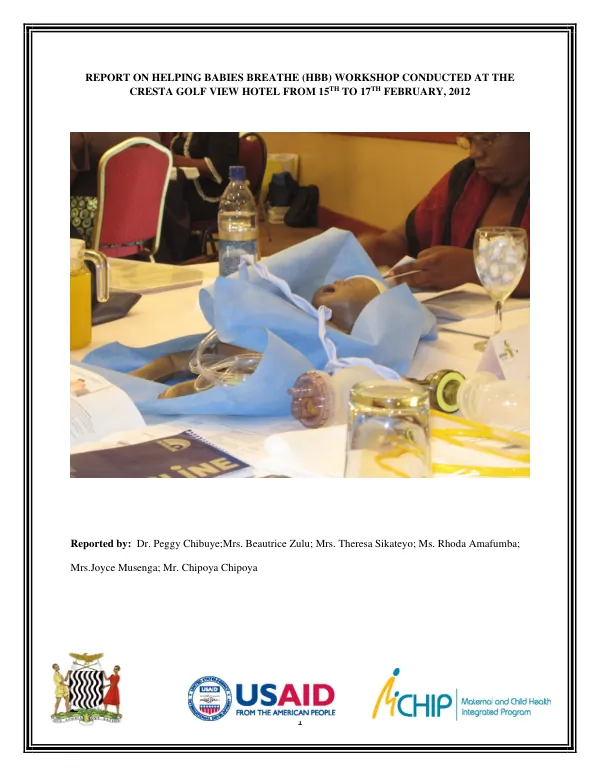
The workshop was organized by MCHIP with support from USAID's Saving Mothers Giving Life initiative. The goal of the workshop was to equip health providers with skills to reduce neonatal morbidity and mortality due to birth asphyxia in four targeted districts of Lundazi, Nyimba, Kalomo, and Mansa. The workshop aimed to enable participants to describe the components of essential newborn care (ENC), describe the relationship between ENC and HBB or newborn resuscitation, develop a work plan for cascading training within their institutions and the country, be equipped to facilitate future national and regional trainings, and develop and share monitoring and evaluation aids to determine knowledge application six months post-training. A team of HBB master trainers was identified to conduct the workshop, including Dr. Peggy Chibuye, Mrs. Beautrice Zulu, Mrs. Theresa Sikateyo, Mrs. Joyce Musenga, Mr. Chipoya Chipoya, and Ms. Rhoda Amafumba. Twenty-two participants were invited to the training, representing clinical partners, MCHIP, CIRDIZ, and Boston University from the four targeted districts. The workshop was officially opened by representatives from the Ministry of Health and Save the Children, emphasizing the importance of the workshop in achieving Millennium Development Goals 4 and 5 concerning neonatal and maternal health. The workshop consisted of presentations by the master trainers, group discussions, and hands-on training using the HBB kit. The participants were divided into small groups and were given a HBB kit for use, although ideally, each participant should have been given a kit to interact with. The step-by-step approach started with opening visualization and review of the HBB training kit, preparation for birth, routine care, the Golden minute part 1, the Golden minute part 2, mastering the HBB action plan, and cleaning and disassembling of the HBB equipment. On the third and final day of the workshop, a post-test questionnaire was administered, followed by an Objective Structured Clinical Examination (OSCE). The results indicated a 100% pass rate. The participants were then asked to prepare action plans on how they would roll out HBB trainings in their respective districts and make presentations before the rest of the groups. The workshop was officially closed by Mr. Marc Nosbach, Country Representative-Save the Children, followed by the awarding of certificates. The participation by participants was encouraging, and adequate master trainers were available to the number of trainees. The individual and group performance in the post-course was impressive. However, challenges were reported, including a participant who reported late for the workshop, missing a whole day of the training, and the HBB training manikin (Neonatalie kit) not being enough according to the standard. Recommendations were made, including all participants checking in before the commencement of the training program, sponsors ensuring that all necessary training materials are available before commencement of the training to avoid perpetuating poor standards, and the EmONC technical working group harmonizing the two resuscitation packages and orienting all trainers.