USAID DEC
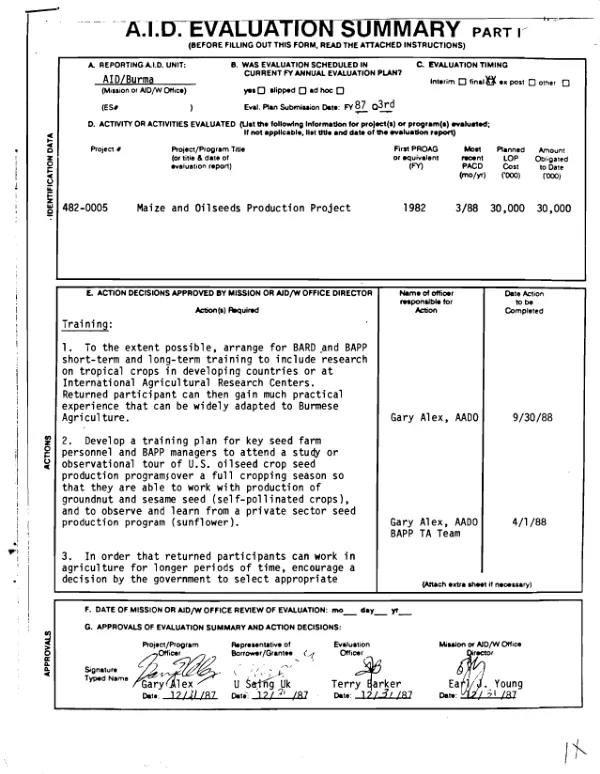
Project assistance completion report : maize and oilseeds production project (482-0005)
Sign inUSAID. MISSION TO BURMA
Project assistance completion report : maize and oilseeds production project (482-0005)
PACR of a project (1981-3/88) to increase oilseed and maize production in 28 rural Burmese townships by providing TA, equipment, and training to improve production techniques and by establishing 4 seed farms.
Alex, Gary E. · 1988
Sign in to readA free account is required to download.
Abstract
Nearly all aspects of the project were highly successful. Production increases exceeded goals for all target crops - groundnuts, sesame, sunflower, and maize - and yields exceeded national averages. A total of 95,600 farm families (approx. 493,000 persons) participated in the project and gross farm income was increased by $225 million. The extensive amount of fertilizer provided by the project and the Government of Burma (GOB) was instrumental in attaining these goals. Considerable effort was spent in adaptive research on fertilizer needs, optimum plant populations, row spacing, and planting dates for project crops. Research on maize and sunflower proved the most useful. This research is necessary in order to generate information on project crops and must be continued. Training goals were nearly met, despite delays in nominating candidates: 24 participants (22 M.Sc., 2 Ph.D.) of a targeted 36 (25 M.Sc., 11 Ph.D.) received U.S. training and were placed in appropriate positions upon their return. A total of 58 (of a targeted 70) persons participated in short-term overseas training programs of 2-6 months. In addition, considerable on-the-job training was provided, along with 33 semi-formal, short courses attended by 831 people. Physical construction is basically completed on the four farms developed by the project for foundation and certified seed production. By the PACD, $6.1 million had been expended on farm equipment and commodities. Management and machinery operation have improved with each planting season, and seasonal activities are usually conducted on time. On the negative side, seed production fell far below original targets due to delays in establishing the farms, shortages of diesel fuel, and changes in crop mix. The project also helped establish a new rhizobium inoculant facility at the Agricultural Research Institute at Yezin. This facility has reached its production maximum, however, and a new facility is needed. Project benefits are likely to be sustained, since participants recognize the advantages of the new technological methods. Moreover, the GOB appears committed to maintaining production increases by increasing fertilizer allocations and by expanding the program to additional townships. Production at the four seed farms will also continue after donor funding has terminated.
Related documents