FINTRAC
Making Your Own Feed - Technical Bulletin #12
The agricultural practice of fish farming in Cambodia involves the use of formulated feed to promote optimal growth and productivity.
2011 · 3 pages
Sign in to readA free account is required to download.
Abstract
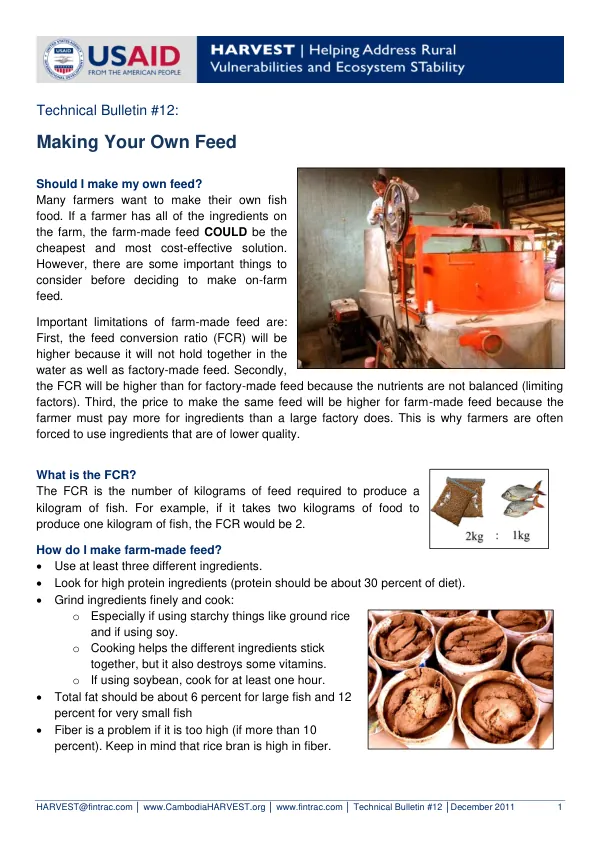
The decision to make on-farm feed is a complex one, as it requires careful consideration of several factors. One of the primary limitations of farm-made feed is its higher feed conversion ratio (FCR), which is the number of kilograms of feed required to produce a kilogram of fish. This is due to the fact that farm-made feed does not hold together in water as well as factory-made feed, resulting in a lower nutrient balance. The FCR is a critical factor in determining the cost-effectiveness of fish farming. It is defined as the number of kilograms of feed required to produce a kilogram of fish, with a lower FCR indicating better feed utilization. For example, if it takes two kilograms of feed to produce one kilogram of fish, the FCR would be 2. In contrast, factory-made feed typically has a lower FCR due to its balanced nutrient composition and better water stability. To make farm-made feed, farmers must use a combination of at least three different ingredients, with a focus on high-protein sources such as soybean and fish meal. The ingredients should be ground finely and cooked to enhance their binding properties and nutrient availability. However, cooking also destroys some vitamins, and soybean requires a minimum of one hour of cooking time. The total fat content of the feed should be around 6% for large fish and 12% for small fish, while fiber content should be limited to less than 10%. The amount of feed required for fish growth depends on several factors, including fish size, feed quality, water temperature, and water quality. Young fish require a high-protein diet and must be fed frequently, while larger fish can be fed less frequently with a lower-protein diet. In addition, fish growth rates can be influenced by factors such as oxygen levels and stocking density, with low oxygen levels and high stocking densities requiring adjustments to feeding schedules. Farmers can choose from a variety of feed formulas, each with its own unique nutrient composition and cost. For example, Formula 1 has a lower protein content and higher fiber content, while Formula 3 has a higher protein content and lower fiber content. The choice of feed formula will depend on the specific needs of the fish and the resources available to the farmer. By carefully selecting the right feed formula and adjusting feeding schedules accordingly, farmers can optimize fish growth rates and productivity while minimizing costs.
Related documents