USAID DEC
Malawi Local Authority Performance Assessment (LAPA) Implementation and Programmatic Issues
Sign inUSAID DEC
Malawi Local Authority Performance Assessment (LAPA) Implementation and Programmatic Issues
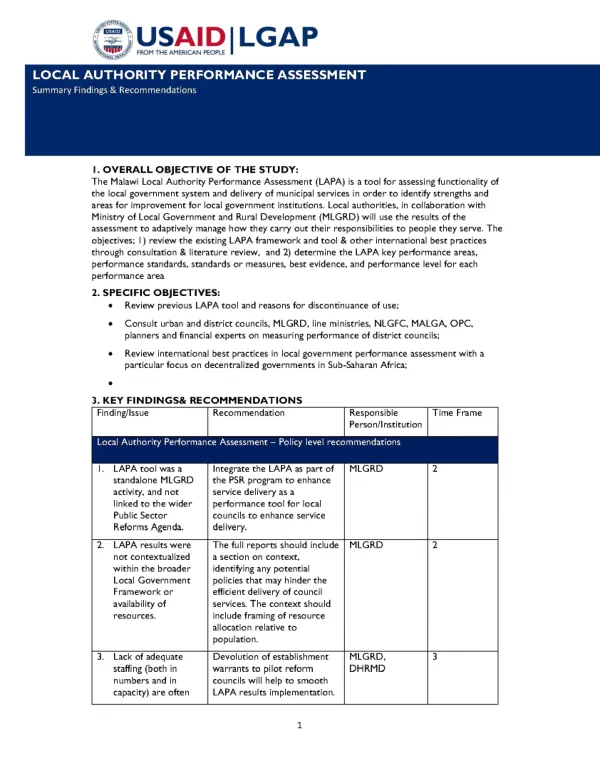
The Malawi Local Authority Performance Assessment (LAPA) is a tool designed to assess the functionality of the local government system and delivery of municipal services in Malawi.
2018 · 3 pages
Sign in to readA free account is required to download.
Abstract
The assessment aims to identify strengths and areas for improvement for local government institutions. Local authorities, in collaboration with the Ministry of Local Government and Rural Development (MLGRD), will use the results of the assessment to adaptively manage their responsibilities to the people they serve. The LAPA framework and tool were reviewed, and international best practices in local government performance assessment were consulted. The assessment identified key performance areas, performance standards, and measures for each performance area. The results of the assessment revealed several findings and recommendations for improvement. One of the key findings was that the previous LAPA tool was viewed as a subjective tool prone to politicization and punitive action for poor performers. The scoring rubric for the previous LAPA left a narrow score range, which made it difficult to assess incremental performance variance between low and high performers. The assessment team recommended that the LAPA design adopt a dashboard and result-based approach with a wider score range to ensure a more incremental performance assessment. The results of the LAPA should be more accepted by districts if they are seen to be independent and apolitical. A comprehensive incentives program needs to be developed to award both local authority and individual performance. Performance should also be measured within the specific contextual environment of the local government, given differences in resource-allocations, district-specific issues, and other contextual factors. The assessment also identified weaknesses in the LAPA process, including the lack of adequate staffing and the failure to address these issues through action planning or additional resources. The LAPA does not drive capacity development, and action planning should inform customized district capacity development plans for staff. The administration of the LAPA did not coincide with the annual budgeting process, leading to long delays in follow-up on identified issues. The sharing of LAPA results was reported to be punitive, and the assessment team recommended that the results be used for lesson sharing and learning among councils instead of "naming and shaming." A communications strategy should be developed to convey the purposes of the LAPA and disseminate results in a constructive yet transparent manner.