GIZ
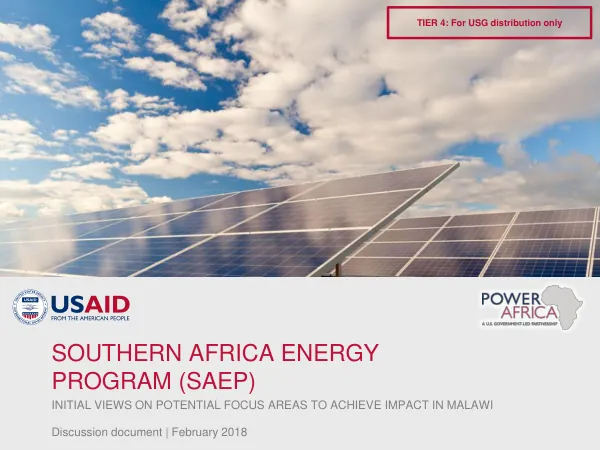
Southern Africa Energy Program (SAEP)
The Southern Africa Energy Program (SAEP) aims to drive 8,800 connections in year one and a total of 800,000 connections until 2022 in Malawi.
2018 · 11 pages
Sign in to readA free account is required to download.
Abstract
This objective is part of a broader effort to increase investment in electricity supply and access in Southern Africa by strengthening the regional enabling environment and facilitating transactions. The program's overall goals by 2022 include increasing capacity by 3,000 MW, developing 1,000 MW transmission capacity, and creating 3 million new connections. Malawi's power sector is undergoing significant changes, with the unbundling of the state-run monopoly utility Electricity Supply Corporation of Malawi (ESCOM) into Generation (EGENCO) and Transmission/Distribution (Tx/Dx) companies. The unbundling is expected to increase network throughput capacity from 260 MW to 960 MW and transmission capacity from 991.5 MVA to approximately 1,661.5 MVA. However, the sector still faces challenges, including heavy reliance on hydropower, power shortages, and excessive load shedding due to decreased dam levels resulting from low rainfall in recent years. The Malawi power sector snapshot highlights the following key statistics: electricity generation by fuel in 2015 was mainly hydro and oil, with installed capacity of approximately 369 MW. Total electrification rate is 12%, with most of this being urban (46%) and rural electrification being only 5%. Peak demand is currently 360 MW, while supply is only 350 MW, resulting in load shedding above 270 MW. Grid installed capacity is aged, although most plants have been rehabilitated. EGENCO plans to expand existing plants and add new capacity. The Malawi power sector has a number of key players, including state-owned entities, independent power producers (IPPs), and donors. The government has signed an agreement with the Millennium Challenge Corporation (MCC) for a revival of the power sector, with support through a compact of 20 years. The MCC has agreed to provide USD305.7 million in support. The power sector is undergoing unbundling, with EGENCO and ESCOM being formed as separate companies. The market is open to private sector participation, with negligible presence of IPPs (<1MW) currently. The areas of opportunity to drive connections in Malawi include the establishment of a Rural Electrification Authority to take over rural electrification from ESCOM, the development of mini-grids, and the promotion of solar home systems. The proposed approach to ensure SAEP drives connections in Malawi includes ESCOM grid densification (urban), ESCOM grid extension (urban), ESCOM (rural), future Rural Electrification Authority, mini-grids, solar home systems, and "large" solar home systems.
Related documents