CREATIVE ASSOCIATES INTERNATIONAL INC.
Mali Peacebuilding, Stabilization, and Reconciliation
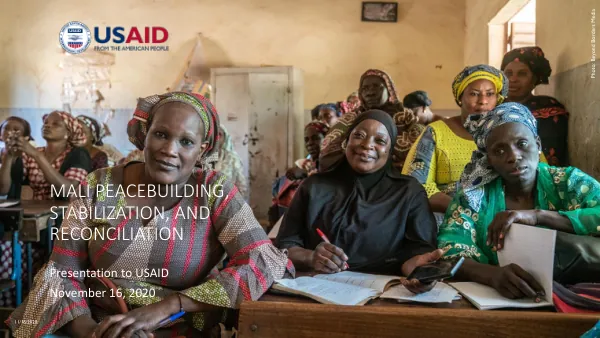
Mali Peacebuilding, Stabilization, and Reconciliation is addressing the root causes of conflict drivers at the commune level.
2020 · 21 pages
Sign in to readA free account is required to download.
Abstract
The initiative leverages U.S. Government investment in all other sectors to amplify and sustain the multi-dimensional response to conflict and extremism at the commune level and respond to peace and security challenges. Research into conflict dynamics shows that weak governance, competition for natural resources, the struggle for legitimacy, and the breakdown of social cohesion are the key grievances that drive violence and conflict in Mali. A multilayered response is being implemented to address the complex challenges in Mali. The goal is to establish a responsible and responsive system of governance for all in Mali. Stabilization efforts include security interventions and counterterrorism, humanitarian aid and rapid-response interventions, conflict management and peacebuilding, and trust-building. Governance and development efforts focus on legitimacy, organization, and capacity building, as well as participatory planning, budgeting, and delivery. Political transition efforts aim to promote social cohesion and communication, legitimacy, organization, and capacity building, and elections. The Mali Peacebuilding, Stabilization, and Reconciliation initiative has several objectives, including community resilience to violence and conflict, inclusive governance and civic engagement, empowering youth and building their resilience to violent extremism, and mitigating the impact of COVID-19 and associated second-order effects on Malian communities. A multilayered approach is being implemented to achieve peace and security, including supporting foundational governance functions to fill key gaps and engage all stakeholders. This involves commune-led conflict diagnosis, mediation, resolution, and prevention, as well as whole community capacity building as governance actors. Trusted relationships are being built to establish social cohesion, ensure inclusion, and restore system legitimacy. This is achieved through collective action, responsible and accountable decisions, and improved performance. The initiative regularly assesses and tracks the level of conflict and instability in the program's 46 communes using a Commune Classification Tool. The tool categorizes communes into conflict, buffer, and resilient categories based on their level of vulnerability to and impact from ongoing conflict, fragility, and weak state presence. The classification is used to inform program implementation and ensure that resources are targeted effectively. Implementation of the multilayered approach is ongoing, with a focus on supporting foundational governance functions and building trusted relationships. The initiative aims to promote community resilience, inclusive governance, and civic engagement, while mitigating the impact of COVID-19 and associated second-order effects on Malian communities. By addressing the root causes of conflict drivers and promoting a responsible and responsive system of governance, the Mali Peacebuilding, Stabilization, and Reconciliation initiative seeks to achieve peace and security in Mali.