USAID DEC
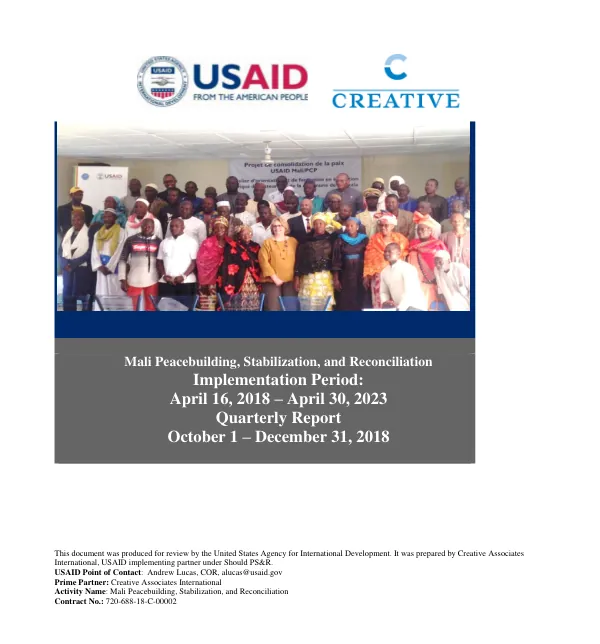
Mali Peacebuilding, Stabilization, and Reconciliation Quarterly Report October 1 – December 31, 2018
Sign inCREATIVE ASSOCIATES INTERNATIONAL INC.
Mali Peacebuilding, Stabilization, and Reconciliation Quarterly Report October 1 – December 31, 2018
The Mali Peacebuilding, Stabilization, and Reconciliation project is a five-year initiative implemented by Creative Associates International, Inc.
2018 · 29 pages
Sign in to readA free account is required to download.
Abstract
in partnership with local organizations, including Association Malienne pour la Survie au Sahel (AMSS) in northern Mali and Think Peace in central Mali. The project aims to improve prospects for long-term peace, security, and reconciliation by building trust between conflict-affected communities and their government, strengthening community resilience to conflict, and empowering marginalized youth as change agents. The project is implemented in 46 conflict-affected communes and communities in the northern and central regions of Mali, including Segou, Mopti, Tombouctou, Gao, Kidal, Menaka, and Taoudeni. The goal is to see measurable improvement in the efficiency, effectiveness, and capacities of local communities to be more resilient to conflict and violent extremism. The project is integrated by three objectives, which support this broader project goal. Objective 1 focuses on developing and piloting organic, community-led conflict early warning, conflict prevention, and violence-reduction mechanisms through inclusive P2P dialogue activities and targeted technical training and support. Objective 2 aims to augment PDSECs to codify peacebuilding and conflict-management mechanisms, including those piloted through Objective 1, and formalize and implement peace-consolidation activities through an inclusive, community-led process. Objective 3 targets youth engagement activities and the creation of alternative livelihoods opportunities to reduce the attraction and influence of violent extremist organizations (VEOs) in project communities. During the past quarter, the USAID/Mali Peacebuilding, Reconciliation, and Stabilization project concluded the initial community engagement sub-activities aimed at mobilizing and gaining support of targeted communities without exacerbating volatile situations. The project delivered on the following key activities as planned: analysis of community engagement dynamics, orientation of strategic actors on the project and selection of priority villages/fractions/quartiers, and selection of key actors and influencers for the project. The analysis of community engagement dynamics involved continued initial contacts with local authorities, identification of key actors/influencers, mapping of CSOs/OCB, administration of six key questions intended to frame initial conversations, and initial analysis of community dynamics and information triangulation aimed at selecting members of the Community Engagement Committees (CECs). The project also conducted its first Orientation Workshop and Training in Civic Education in Markala, where field staff administered questions in the 44 communes, mapped out youth opportunities, and identified initial dynamics related to conflicts and governance that will feed more detailed research in the next quarter. The project's community engagement update by region indicates that key actors and influencers have been identified, CSOs and CBOs have been mapped, and key questions have been administered to frame initial conversations. The project has also conducted a pilot orientation workshop coupled with civic engagement training and an overview of key national policies and strategies in the commune of Markala for 53 people, including 29 chefs de villages.