SAVE THE CHILDREN FUND
MaMoni Health Systems Strengthening Activity: FY’16 Q2 Quarterly Report
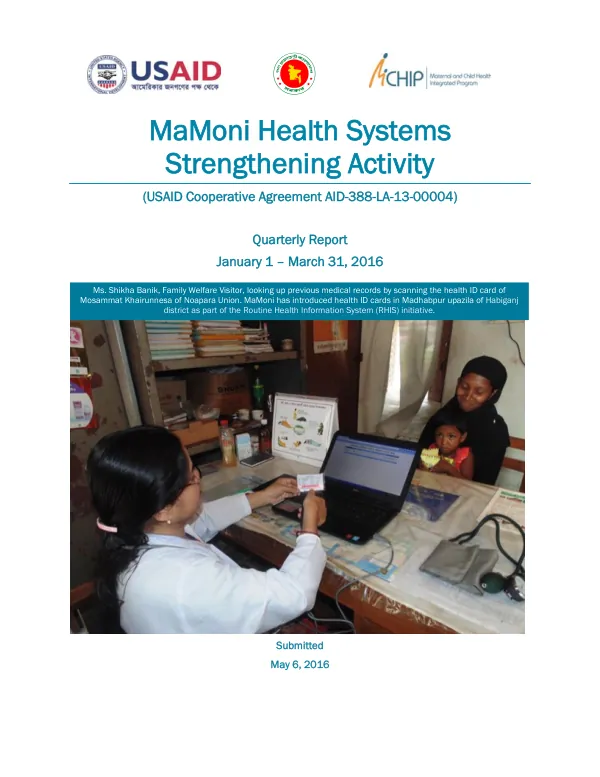
The MaMoni Health Systems Strengthening Activity is a project implemented in Bangladesh under the USAID Cooperative Agreement AID-388-LA-13-00004.
2016 · 68 pages
Sign in to readA free account is required to download.
Abstract
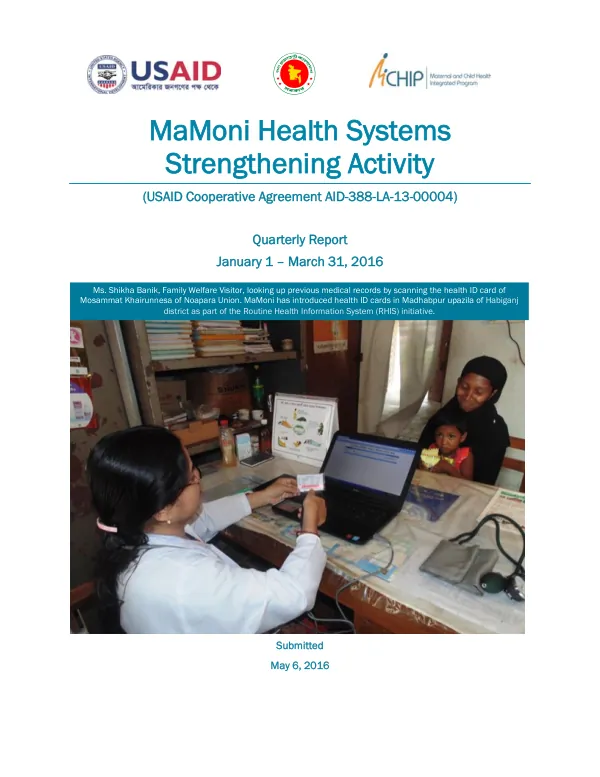
The project aims to strengthen the health systems in Bangladesh, particularly in the areas of maternal, newborn, and child health (MNCH) and family planning (FP). The project is being implemented in collaboration with the Directorate General Family Planning (DGFP) and the Directorate General Health Services (DGHS) MOH&FW. One of the key accomplishments of the project in the second quarter of year three is the assessment of all Union Health and Family Welfare Centers (UH&FWCs) in Bangladesh for readiness to provide 24/7 delivery services. As of March 31, 2016, all remaining facilities of Dhaka, Khulna, and Rajshahi divisions have been completed, bringing the total assessment to 4,463 out of an initially projected 4,000+ health facilities nationwide. The project has also been supporting the routine health information system (RHIS) initiative of the DGHS MOH&FW to pilot the automated population registry system (PRS) in Madhabpur and Lakhai upazilas of Habiganj district. As of March 31, 2016, 3,323 household members in 621 households of Lakhai upazila of Habiganj district have been registered. In Madhabpur upazila, where PRS has been completed, 1,823 health ID cards were distributed in two unions in late March 2016. The project has also introduced offline capability so that the data can be entered offline at the service delivery point (SDP) level. In three unions of Madhabpur, Family Welfare Visitors (FWVs) recorded service data of 1,994 ANC, delivery, and PNC in the maternal, newborn, and child health (MNCH) e-register. The project has also developed FP modules to record service data of pill, condom, injectables, and IUD. The project has also organized three divisional advocacy meetings in Chittagong, Rangpur, and Khulna divisions. Additionally, the project has validated some of the key indicators of the data through an independent team of 6 who visited 7 divisions, and through its periodic service delivery point (SDP) assessment in Lakshmipur district. The MaMoni Health Systems Strengthening Activity is being implemented in collaboration with various stakeholders, including the DGFP, DGHS MOH&FW, and other government and non-government organizations. The project aims to improve the health outcomes in Bangladesh, particularly in the areas of MNCH and FP. The project has made significant progress in the second quarter of year three, with a total of 4,463 UH&FWCs assessed for readiness to provide 24/7 delivery services. The project has also made significant progress in the implementation of the RHIS initiative, with 3,323 household members registered in Lakhai upazila and 1,823 health ID cards distributed in Madhabpur upazila. The project has also developed FP modules to record service data of pill, condom, injectables, and IUD. The project has also organized three divisional advocacy meetings and validated some of the key indicators of the data through an independent team of 6 who visited 7 divisions, and through its periodic service delivery point (SDP) assessment in Lakshmipur district. Overall, the MaMoni Health Systems Strengthening Activity is making significant progress in strengthening the health systems in Bangladesh, particularly in the areas of MNCH and FP. The project aims to improve the health outcomes in Bangladesh and is being implemented in collaboration with various stakeholders.