SAVE THE CHILDREN FUND
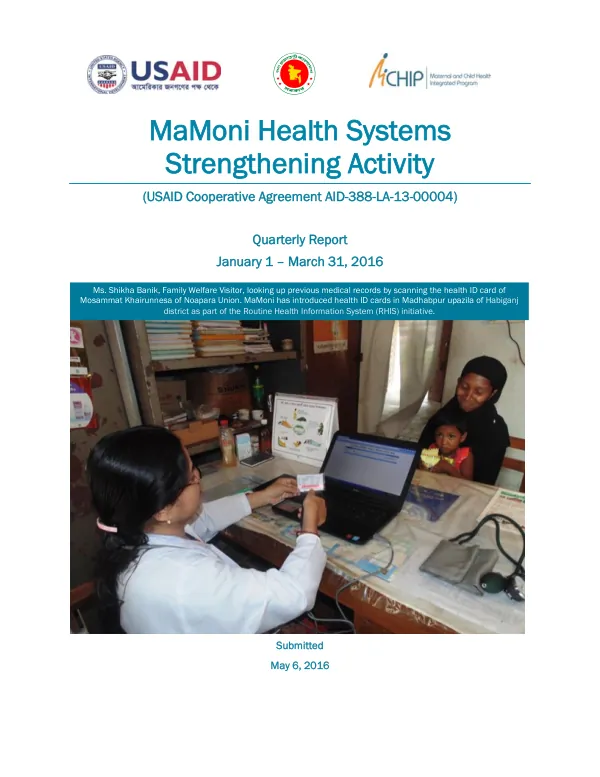
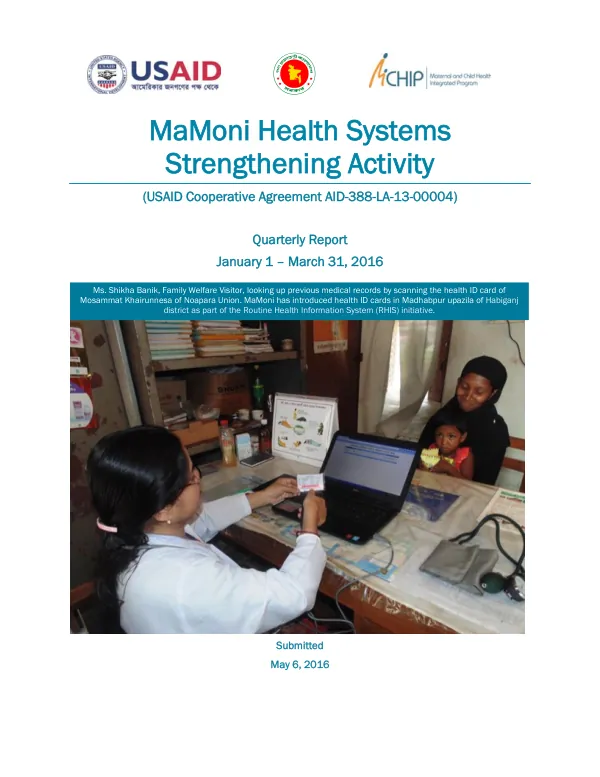
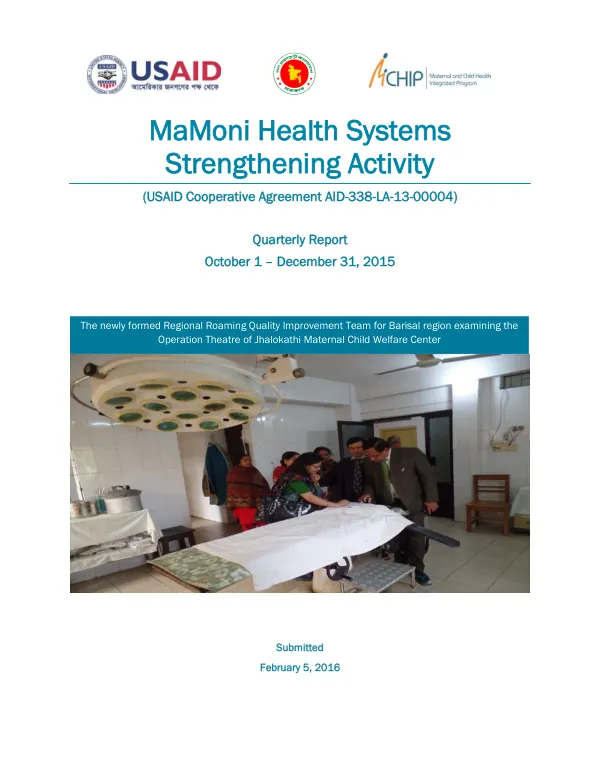
MaMoni Health Systems Strengthening Activity: FY’16 Q1Quarterly Report
The MaMoni Health Systems Strengthening Activity is a project implemented in Bangladesh under the USAID Cooperative Agreement AID-338-LA-13-00004.
2016 · 65 pages
Sign in to readA free account is required to download.
Abstract
The project aims to strengthen health systems in Bangladesh, particularly in the areas of maternal, newborn, and child health (MNCH). The project is being implemented in collaboration with the Directorate General Family Planning (DGFP) and the Directorate General Health Services (DGHS) of the Ministry of Health and Family Welfare (MOH&FW). In the first quarter of year three, the project achieved several key accomplishments. The project supported the DGFP in assessing all Union Health and Family Welfare Centers (UH&FWCs) in Bangladesh for readiness to provide 24/7 delivery services. A total of 1,703 UH&FWCs in Rangpur division and parts of Dhaka, Khulna, and Rajshahi divisions were assessed, bringing the total assessment to 3,052 out of a projected 4,000 health facilities nationwide. The preliminary findings from the assessments were reported at the first meeting of the technical assistance cell (TAC) at DGFP. The project also supported the routine health information system (RHIS) initiative of DGHS to pilot the automated population registry system (PRS). As of December 31, 2015, 342,200 household members in 47,802 households of Madhabpur upazila of Habiganj district had been registered. Preparations were completed to introduce PRS in Lakhai upazila in January 2016. Family Welfare Visitors (FWVs) were trained to record service data in maternal, newborn, and child health (MNCH) e-register, which includes antenatal care (ANC), delivery, newborn, and post-natal care (PNC) modules of the UH&FWC register. The project successfully advocated with DGHS to place four gynecology consultants and two anesthesia consultants in Comprehensive Emergency Obstetric and Newborn Care (CEmOC) designated centers. These staff were posted in Habiganj and Jhalokathi district hospitals, Hatiya Upazila Health Complex (UHC) in Noakhali district, Ajmiriganj and Baniachang UHC in Habiganj district. The project is working with the district administration to ensure that these consultants stay at their workplace and contribute to improve CEmONC service delivery. The project also supported the national scale-up of Chlorhexidine support, which included training of 17,077 service providers in 20 districts. In January 2016, the Chlorhexidine procurement was transferred to the Central Medical Store Depot (CMDS). The project is working to ensure that the trained service providers are able to use the Chlorhexidine effectively and that the procurement process is smooth and efficient. The project is being implemented in several districts across Bangladesh, including Rangpur, Dhaka, Khulna, and Rajshahi. The project is working closely with the district administration, the DGFP, and the DGHS to ensure that the project activities are aligned with the national health policies and strategies. The project is also working to ensure that the project activities are sustainable and that the benefits of the project are sustained beyond the project period. The project has made significant progress in the first quarter of year three, and the project is on track to achieve its objectives. The project will continue to work closely with the stakeholders to ensure that the project activities are effective and sustainable. The project will also continue to monitor and evaluate the project activities to ensure that the project is meeting its objectives and that the benefits of the project are sustained beyond the project period.