GOVERNMENT OF BANGLADESH
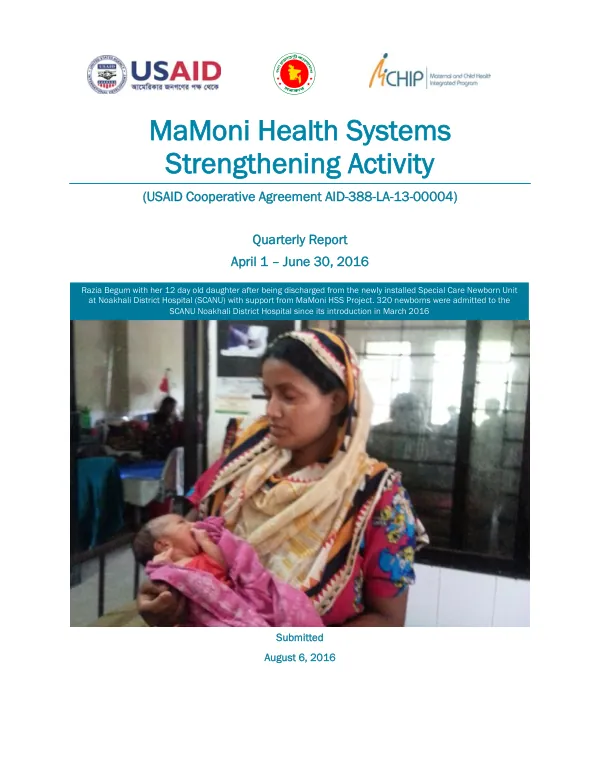
MaMoni Health Systems Strengthening Activity: FY’16 Q3 Quarterly Report
MaMoni Health Systems Strengthening Activity is a project implemented in Bangladesh under the USAID Cooperative Agreement AID-388-LA-13-00004.
2016 · 66 pages
Sign in to readA free account is required to download.
Abstract
The project aims to strengthen health systems at the district level and below, with a focus on improving maternal, newborn, and child health. In the third quarter of Year Three, the project achieved several key accomplishments. An assessment of all 4,461 union level health facilities was completed to determine their readiness to provide normal delivery care and essential newborn care services. A comprehensive database of these facilities was prepared, which will be used to advocate for investments from the Ministry of Health and Family Welfare (MOHFW) and development partners to strengthen these facilities. The project also completed the initial rollout of 7.1% chlorhexidine application for newborn umbilical cord care through public sector health facilities in all 64 districts of the country. The Ministry of Health and Family Welfare (MOHFW) is supporting the rollout by procuring and distributing the product, while the project has supported the training of all public sector health workers, supervisors, and managers at all levels. The project has also integrated chlorhexidine into the routine monitoring systems of MOHFW. Furthermore, the project has signed three important letters of collaboration (LOC) with different units of MOHFW at the national level. The first LOC aims to support the Planning Wing of MOHFW to coordinate the development of the fourth Health, Nutrition, and Population (HNP) sector program. The second LOC supports the Health Economics Unit (HEU) to strengthen the role and capacity of the Quality Improvement Secretariat (QIS) to nationally roll out the National Quality Improvement Strategic Plan. The third LOC supports the Health Systems Strengthening Unit (HSSU) to strengthen the capacity of the MOHFW to implement the National Health Systems Strengthening Strategy. The project has also made progress in promoting an enabling environment to strengthen district-level health systems. This includes supporting the development of a comprehensive database of union level health facilities, which will be used to advocate for investments to strengthen these facilities. The project has also supported the integration of chlorhexidine into the routine monitoring systems of MOHFW. In terms of challenges, the project faced difficulties in mobilizing the support of private sector providers, NGOs, and other development partners to promote the use of chlorhexidine as part of essential newborn care for babies in the country. However, the project has made progress in addressing these challenges and has mobilized the support of several key stakeholders. Overall, the MaMoni Health Systems Strengthening Activity has made significant progress in strengthening health systems at the district level and below, with a focus on improving maternal, newborn, and child health. The project has achieved several key accomplishments, including the completion of an assessment of all 4,461 union level health facilities, the initial rollout of chlorhexidine application for newborn umbilical cord care, and the signing of three important letters of collaboration with different units of MOHFW at the national level.