USAID DEC
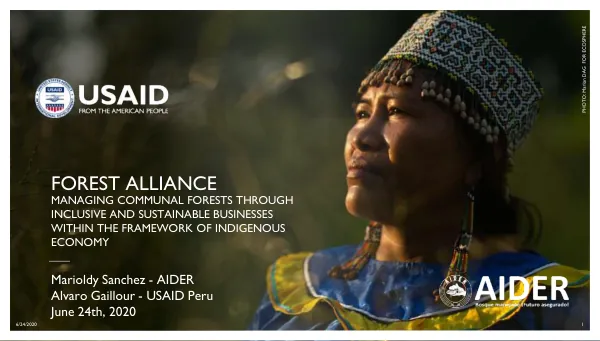
Managing Communal Forests Through Inclusive and Sustainable Businesses Within the Framework of Indigenous Economy
Sign inAIDER
Managing Communal Forests Through Inclusive and Sustainable Businesses Within the Framework of Indigenous Economy
The Forest Alliance supports indigenous communities in Ucayali to conserve and manage their forested lands under a Green Development Agreement.
2020 · 18 pages
Sign in to readA free account is required to download.
Abstract
Althelia Mirova works with AIDER in conserving communal forests and marketing the carbon stocks conserved, thus generating profits for the Alliance. The region is home to 418,000 people, 2,700 communities, and 40 languages, with indigenous livelihoods negatively impacted by ecosystem degradation and extractive economic activities. Main economic activities in the region include agriculture and fishing, primarily for subsistence. However, very few businesses are led by indigenous peoples, and there is a high migration of indigenous youth to cities seeking job opportunities. The Forest Alliance aims to address these challenges through inclusive and sustainable businesses for communal forest management. The problem addressed by the Forest Alliance is socio-economic exclusion, where indigenous entrepreneurships achieve social and environmental progress but are weakly included in overall value chains. Businesses with no cultural pertinence and limited access to funding sources exacerbate the issue. Barriers to a trust relationship with the private sector further hinder progress. The Forest Alliance's Theory of Change involves several key elements. Conservation Enterprises support is provided to indigenous companies, such as Nii Biri, through training and technical assistance. Enabling conditions, including strengthened governance, land tenure security, and public funds mobilized, are established to reduce threats and promote restoration contributing to biodiversity conservation. Economic benefits enable conservation behaviors, and reduced threats lead to forest coverage maintenance and greenhouse gas emissions reduction. The Forest Alliance's activities and progress include supporting CE: Nii Biri indigenous company through training on the ground, learning by doing, and experience exchange. Agroforestry, forest plantations, timber, and non-timber forest products, handcrafting, and REDD+ are implemented, along with forest management plans, FSC certification, and forest governance aligned to Life Plans. Financial sustainability plans are developed, and business social organization, access to markets, legal, technical, and business training are provided. Economic activities are business-oriented, and forest management technical assistance and business support are offered.