OPEN UNIVERSITY
Document PA-00Z-WMW
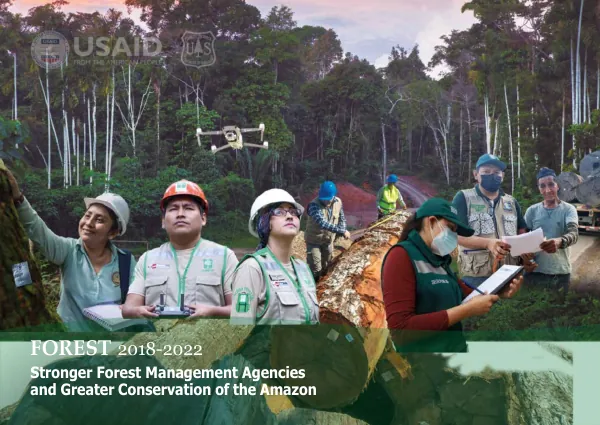
The national and regional forest and wildlife authorities responsible for managing Peru's forest and wildlife resources underwent institutional strengthening through the FOREST program from 2018 to 2022.
2022 · 40 pages
Sign in to readA free account is required to download.
Abstract
The program, carried out in collaboration with the USAID and U.S. Forest Service, contributed to the development of a forest sector that is legal, modern, competitive, and sustainable. The FOREST program focused on strengthening Peru's forest and wildlife authorities, particularly in the management of concessions and communities. This effort aimed to increase the amount of forest area under legal and sustainable management, thereby reducing illegal logging. The program identified Loreto and Ucayali as its initial area of action and later extended its scope to Madre de Dios, regions that account for about 80% of Peru's timber production. The program was organized around five main strategies: implementation of forest regulations; availability, use, and transparency of forest data; forest sector capacity-building; strengthening forest authority public management; and strengthening academia and forestry research. Technical cooperation provided through FOREST strengthened eight institutions, including the National Forest and Wildlife Service (SERFOR), Forest and Wildlife Resources Oversight Agency (OSINFOR), and Regional Governments of Loreto, Ucayali, and Madre de Dios. FOREST helped mobilize $20.35 million in investment for the forest sector. In addition, 6,504 people were trained, of whom 4,088 were men and 2,416 were women. Technical support was provided to produce 144 laws, policies, and regulations, of which 82 were approved and are being implemented. A total of 334 studies were produced, and FOREST supported 12 students who pursued a Master's of Natural Resources at Oregon State University. The program's implementing partners were the Peruvian Society for Environmental Law (SPDA), Law, Environment and Natural Resources (DAR), the Institute for the Common Good (IBC), Oregon State University (OSU), and World Resources Institute (WRI). The FOREST program's efforts contributed to the development of a more sustainable and responsible forest sector in Peru. The program's achievements include the creation of the Technical Working Group on Forestry and Wildlife Information, the development of an abbreviated procedure for new concessions, and the creation of the Strategic Monitoring Unit at OSINFOR. Additionally, the program supported the development of regulations for the Satellite Monitoring Unit, the creation of virtual classrooms for SERFOR and OSINFOR, and the publication of the National Forestry and Wildlife Research Plan. FOREST's work also focused on combating illegal logging and associated trade. The program supported the development of a new national strategy to fight illegal logging, the creation of the Tahuamanu FFS Management Unit, and the establishment of the Web and mobile application of the FFS Concordada Law. The program also contributed to the development of a more transparent and accountable forest sector, with a focus on the availability, use, and transparency of forest data. The program's results include the implementation of 144 laws, policies, and regulations, the production of 334 studies, and the training of 6,504 people. The program also supported the development of a more sustainable and responsible forest sector in Peru, with a focus on the management of concessions and communities. The FOREST program's efforts contributed to the development of a more transparent and accountable forest sector, with a focus on the availability, use, and transparency of forest data.
Related documents