USAID DEC
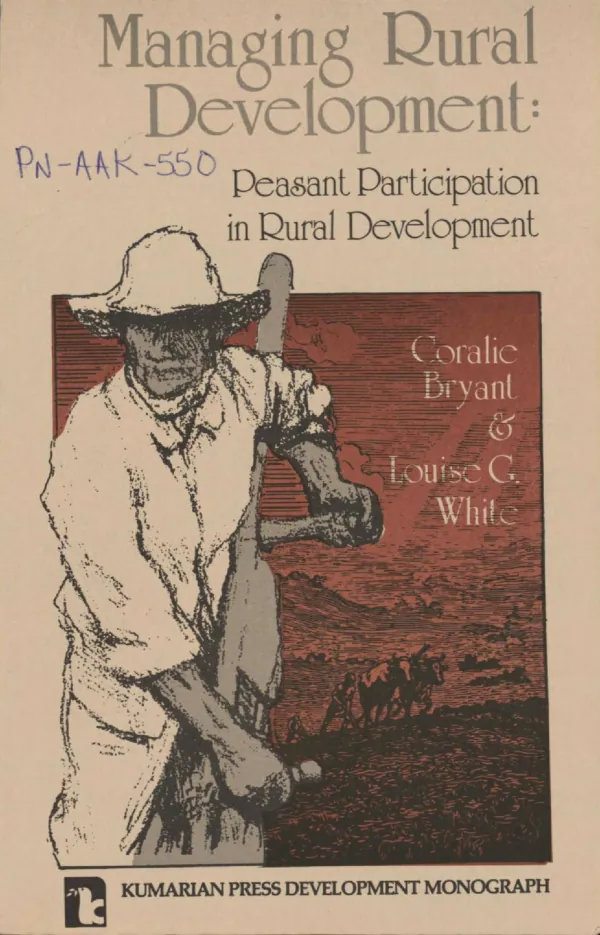
Managing rural development : peasant participation in rural development
Although the vast majority of the world"s poor are rural peasants, development planners have only very recently come to view rural development as the major goal of national development and recognized the centrality of peasant participation in the rural development process.
Bryant, Coralie; White, L. G. · 1970
Sign in to readA free account is required to download.
Abstract
Tracing the evolution of the rural development concept from early emphasis on merely increasing production to recent integrated rural development programs geared toward raising rural incomes, the authors advocate "bottom-up" planning which emphasizes the expeditious flow of information from participants to planners. Hence, the planner must act as interpreter of community aspirations, strategist, infuser of values, decisionmaker, negotiator, organization architect, ambassador, and public spokesman. Expressing participation as a function of anticipated benefits multiplied by the probability of their being achieved, the authors state that while collective action is socially desirable, collective effort is seldom individually attractive. To deal with this dilemma, they suggest that planners improve their listening and communication skills in order to heighten awareness of participants" preferences; change public into private benefits for participants (i.e., by restricting access to benefits only to participants or by exacting a fee from non-participants); and turn participation into a benefit rather than a cost (e.g., through use of social incentives). Specific management strategies are offered: (1) build on the peasants" primary goals; (2) think "small" and "simply"; (3) build on existing organizations and leaders; and (4) link local groups to external sources of support. As an alternative to the "bottom-up" approach, the authors suggest reforming and reorienting agricultural extension services. Finally, in implementing decentralized projects, the authors caution planners against: reinforcing the power of local elites; fostering ambiguity in the roles and responsibilities of project staff and local leaders; allowing projects to cause undue competition among participating groups; and undermining local self-reliance. A 55-item bibliography (1930-79) is included.
Related documents
Documents in this collection
 1970
1970USAID DEC
Management performance for rural development : packaged training or capacity building
Open record 1970
1970USAID DEC