USAID DEC
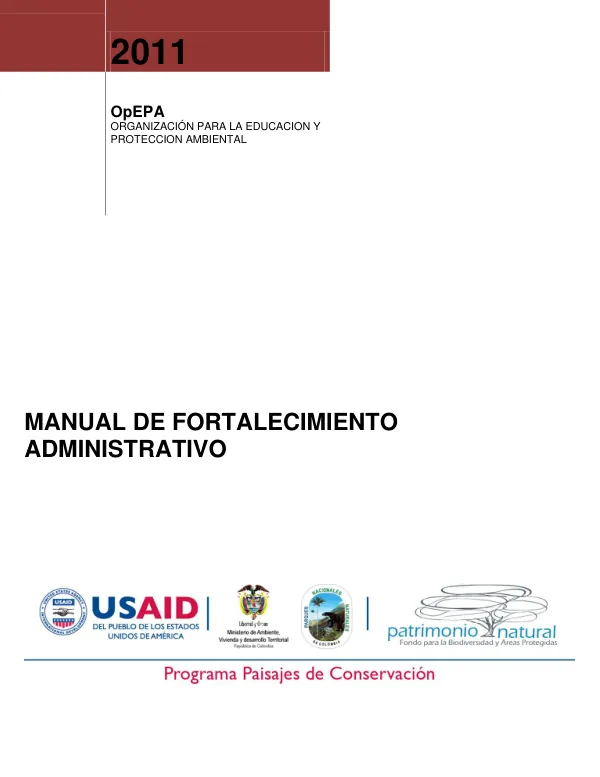
Manual de Fortalecimiento Administrativo
The Organización para la Educación y Protección Ambiental (OpEPA) is a Colombian organization that provides educational and environmental protection services.
2011 · 51 pages
Sign in to readA free account is required to download.
Abstract
The organization has developed a manual for administrative strengthening, which aims to provide tools and knowledge to help organizations formalize their operations and improve their administrative and financial management. The manual is divided into several modules, each focusing on a specific aspect of administrative strengthening. The first module, Autodiagnóstico Organizacional, is designed to help organizations evaluate their current situation and identify their strengths and weaknesses. This module includes a self-assessment questionnaire that helps organizations determine their level of administrative maturity. The questionnaire assesses various aspects of an organization's operations, including its legal status, financial management, and communication systems. The results of the questionnaire are used to determine the organization's level of administrative maturity, which is categorized as follows: * 91-100 points: The organization has a high level of administrative maturity and is well-structured and formalized. * 61-90 points: The organization has made significant progress in administrative strengthening, but still needs to address some areas of improvement. * 0-60 points: The organization is operating informally and needs to initiate the process of legalization and administrative strengthening. The second module, Aspectos Administrativos, focuses on the administrative aspects of an organization, including emprendimiento (entrepreneurship), the type of organization, and the constitution of the organization. This module provides information on the different types of organizations, including cooperatives and gremios, and the requirements for constituting a legal entity. The module also covers the importance of good communication and the tools needed to achieve effective communication within an organization. Additionally, it provides information on the different types of communication, including verbal and non-verbal communication. The third module, Aspectos Contables, focuses on the accounting aspects of an organization, including the importance of accounting, the different types of accounting systems, and the preparation of financial statements. This module provides information on the different types of accounting systems, including the cash system and the accrual system, and the preparation of financial statements, including the balance sheet and the income statement. The manual also includes a section on Aspectos Tributarios, which focuses on the tax aspects of an organization, including the different types of taxes, tax obligations, and tax returns. This module provides information on the different types of taxes, including income tax and value-added tax, and the tax obligations of an organization, including the payment of taxes and the filing of tax returns. Overall, the manual provides a comprehensive guide to administrative strengthening for organizations, covering various aspects of administrative and financial management. It is designed to help organizations formalize their operations, improve their administrative and financial management, and achieve greater efficiency and effectiveness.
![Guía para Evaluación Rápida de Daños y Manual Para diligenciamiento del Formulario de ERD [V2.1]](https://covers.devme.ai/gen/143436.webp)