USAID DEC
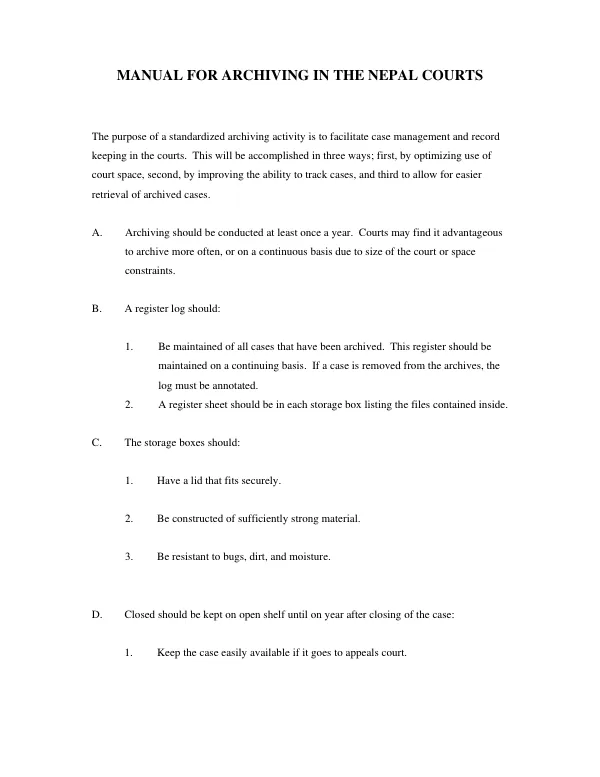
MANUAL FOR ARCHIVING IN THE NEPAL COURTS
Standardized archiving in the Nepal courts is essential for efficient case management and record keeping.
2 pages
Sign in to readA free account is required to download.
Abstract
This process optimizes court space, improves case tracking, and facilitates easier retrieval of archived cases. Archiving should be conducted at least once a year, with the option to archive more frequently or continuously, depending on the court's size and space constraints. A register log is maintained to track all cases archived, with annotations made when a case is removed from the archives. Each storage box contains a register sheet listing the files inside. Storage boxes are designed to be secure, durable, and resistant to bugs, dirt, and moisture. They have a lid that fits securely and are constructed of strong material. Closed cases are kept on open shelves for one year after the case is closed, allowing for easy access if the case goes to the appeals court. Destruction of one-year documents can be performed before archiving, saving space and eliminating the need for future purging. The boxes used for archiving are clearly marked for identification, with the range of cases stored and a sequential number. They are stored in numerical order or a logical sequence to facilitate retrieval. Archived cases are stored off the floor to protect them from moisture and other environmental elements. The same numbering system used for open cases is maintained for archived cases. Upon initial archiving, boxes are filed about 90% full to allow for future additions. Archived case files are filed in numerical order within the storage box and stored vertically to make them easier to find. This standardized approach to archiving ensures that case files are organized, accessible, and protected, supporting the efficient operation of the Nepal courts.
Related documents