USAID DEC
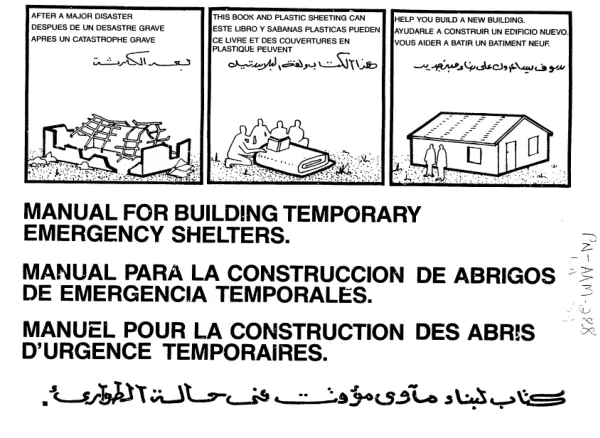
Manual for Building Temporary Emergency Shelters
The manual for building temporary emergency shelters is designed to assist local disaster officials in responding to post-disaster community shelter problems.
281 pages
Sign in to readA free account is required to download.
Abstract
The manual utilizes plastic sheeting as a primary construction material, allowing individuals to adapt the sheeting to their specific needs rather than adjusting their needs to the characteristics of the plastic sheeting. The manual begins with a graphic vocabulary section, which includes illustrations and corresponding terms to help users understand the drawings and ideas presented in the manual. This section includes terms such as "ground," "people," "tree," "basic shelter," and "shelter covered with plastic sheeting." The vocabulary is presented in multiple languages, including English, French, and Spanish. The manual also includes a table of contents, which outlines the various sections and topics covered in the manual. The sections include an introduction, graphic vocabulary, and a series of illustrations and explanations of different construction techniques, including masonry block or brick construction, rubble or stone wall construction, timber construction, bamboo construction, log or pole construction, and woven mat construction. The manual also addresses various disaster conditions, including flooding, earth or rock slide, earthquake, wind, and strong winds. It provides illustrations and explanations of how to construct shelters in these conditions, including how to secure the shelter against wind and how to build a shelter on uneven terrain. In addition to construction techniques, the manual also addresses various environmental factors, including hot/dry climate, hot/wet climate, cold climate, and cold temperature. It provides guidance on how to construct shelters that are suitable for these conditions, including how to provide ventilation and how to insulate the shelter. The manual also includes a section on foundations, walls, roof, and doors, which provides guidance on how to construct a shelter that is safe and secure. It also includes a section on danger, direction of movement, and windows, which provides guidance on how to identify potential hazards and how to construct a shelter that is safe and secure. Overall, the manual provides a comprehensive guide for building temporary emergency shelters, including construction techniques, environmental factors, and safety considerations. It is designed to assist local disaster officials in responding to post-disaster community shelter problems and to provide individuals with the knowledge and skills necessary to build a safe and secure shelter.