CATHOLIC RELIEF SERVICES ORGANIZATION
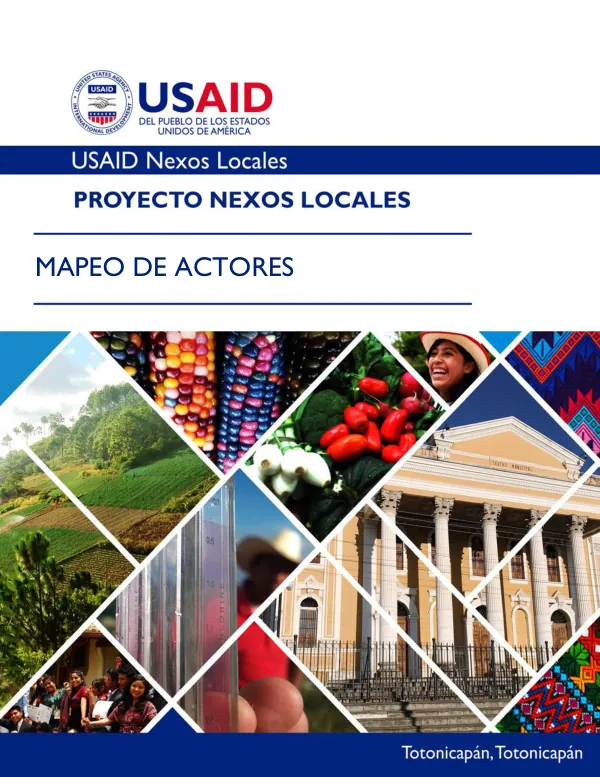
MAPEO DE ACTORES EN EL MUNICIPIO DE TOTONICAPÁN
The municipality of Totonicapán is located in the eastern part of the department, situated in the southwestern altiplano of Guatemala at an elevation of 2,495 meters above sea level.
2018 · 10 pages
Sign in to readA free account is required to download.
Abstract
The municipality covers an area of 328 square kilometers and is divided into four zones: Palín, Independencia, Agua Caliente, and Tenerías, as well as three colonies. Additionally, there are ten rural aldeas and 23 cantones, which are further subdivided into 232 parajes. The municipality is currently administered by Ing. Luis Alfredo Herrera Amado, who began his term in 2016 and will serve until 2020. During his tenure, various administrative and management processes have been renewed due to the previous line of political leadership. It is essential to note that Totonicapán has a unique political and cultural structure, consisting of two levels of authority: the official authority, represented by the Alcalde Municipal and the Concejo, and the ancestral authority, comprising 48 cantones. The Alcalde and the Concejo maintain an open and supportive relationship with the municipal dependencies, facilitating the implementation of actions and proposals from each office. The society civil has recognized the efforts of the current municipal administration, despite the most vulnerable and sensitive issues for the population, such as water and waste management. The organization of 48 Cantones plays a crucial role in the municipality, serving as a fundamental actor and holding legitimate authority. Understanding their internal structure is essential for developing processes in the municipality, focusing on strengthening the relationship between the Concejo Municipal and the Cantones. The Consejo Municipal de Desarrollo (COMUDE) was formed during the current municipal administration, as it was not established in previous periods. The COMUDE has organized commissions, although they are not yet integrated by the corresponding sectors. It is necessary to promote and strengthen the integration of COMUDE members. The Alcaldía Municipal has shown a willingness to improve the performance of the COMUDE, which should be transmitted to the entire Concejo Municipal to generate greater changes for the municipality. Institutional intervention for the strengthening of the municipality and the COMUDE is essential. Institutions socialize with the COMUDE, externalize their opinions on discussed topics, and participate in the municipality. Some of the institutions that have intervened in the municipality include the Asociación de Desarrollo Integral Para el Occidente (ADIPO), which executes the SEGAMIL project as a partner of USAID, and the Secretaría de Planificación (SEGEPLAN), which is updating the Plan de Desarrollo Municipal (PDM). The Dirección Municipal de la Mujer (DMM) is supporting the formation of leadership and visibility of women's roles in various spaces. However, there is a need to work more on their position in decision-making at the community and municipal levels. The Oficina Municipal de la Juventud (OMJ) was recently established, focusing on participation and capacity-building for the labor market, with the support of the Leer y Aprender project and the Catholic Relief Services (CRS) organization. The OMJ has identified that the unemployment rate in the municipality is forcing young people to emigrate, prompting initiatives to motivate them to stay. The youth in Totonicapán are described as visionary and progressive. It is essential to note that the organizations listed in this document are those identified during the rapid survey and do not imply that they are the only ones intervening in the municipality.
Related documents