CATHOLIC RELIEF SERVICES ORGANIZATION
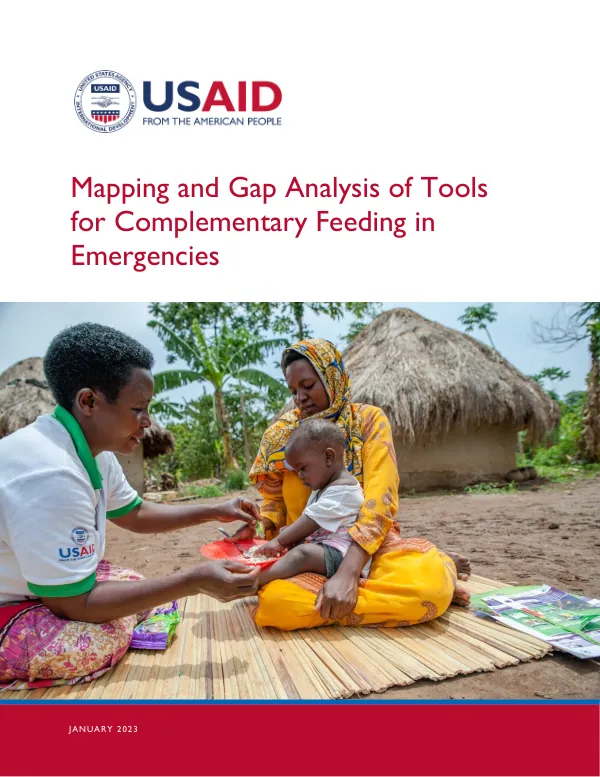
Mapping and Gap Analysis of Tools for Complementary Feeding in Emergencies
Complementary Feeding in Emergencies is a critical component of nutrition programming in humanitarian contexts.
2023 · 55 pages
Sign in to readA free account is required to download.
Abstract
Improving infant and young child feeding (IYCF) practices, including exclusive breastfeeding (BF) and complementary feeding (CF), is essential for achieving nutrition objectives in children under the age of two. In emergency contexts, protecting, maintaining, and potentially improving nutrition outcomes in children is a central focus of nutrition programming. The importance of complementary feeding in emergencies has been recognized in recent years, with a growing emphasis on supporting IYCF in emergency contexts. However, the focus of activities has typically been on promoting exclusive breastfeeding, with relatively less emphasis on complementary feeding practices. A 2020 review published by the Infant Feeding in Emergencies Core Group (IFE Core Group), the Emergency Nutrition Network (ENN), and the former United States Agency for International Development Office of Foreign Disaster Assistance (USAID-OFDA) identified a key barrier to complementary feeding programming in emergencies (CFE) as the lack of knowledge on what an effective and efficient CFE intervention consists of, and the tools needed to implement CFE programming in emergency contexts. To address this need, the IFE Core Group and the United Nations Children's Emergency Fund (UNICEF) developed the Operational Guidance for Infant Feeding in Emergencies (OG-IFE), which includes guidelines for complementary feeding in emergencies. The OG-IFE provides a framework for implementing effective and efficient CFE interventions, including recommendations for tools and resources needed to support CFE programming in emergency contexts. A mapping and gap analysis of tools for complementary feeding in emergencies was conducted to identify existing tools and resources available to support CFE programming. The analysis categorized tools into three tiers, with Tier 1 including OG-IFE recommended actions guidelines, Tier 2 including UNICEF action framework recommendations, and Tier 3 including online repositories of CFE resources. The analysis found that while there are existing tools and resources available to support CFE programming, there are still gaps in the availability and accessibility of these tools, particularly in emergency contexts. Stakeholder perspectives on the availability and accessibility of tools for CFE programming were also examined as part of the analysis. The findings suggest that while some stakeholders have access to a range of tools and resources, others face significant barriers in accessing these tools, including limited internet connectivity and lack of technical expertise. The analysis highlights the need for improved access to tools and resources for CFE programming, particularly in emergency contexts. The implications of the gaps in the availability and accessibility of tools for CFE programming are significant, with potential consequences for the effectiveness of CFE interventions and the nutrition outcomes of children in emergency contexts. To address these gaps, the analysis recommends the development of new tools and resources, as well as the improvement of existing tools to make them more accessible and user-friendly. The analysis also highlights the need for increased investment in capacity building and technical assistance to support the implementation of CFE programming in emergency contexts.
Related documents
Documents in this collection
 2018
2018USAID DEC
Improving the Nutritional Value of Foods in the USAID Food Aid Basket: Optimization of Macro and Micronutrients, Food Matrices, Novel Ingredients and Food Processing Technologies
Open record 2017
2017USAID DEC