JSI RESEARCH & TRAINING INSTITUTE, INC
Prioritizing Multi-Sectoral Nutrition Behaviors
Nutrition-specific behaviors are pre-populated in the tool for prioritizing behaviors during multi-sectoral nutrition program design.
2021 · 8 pages
Sign in to readA free account is required to download.
Abstract
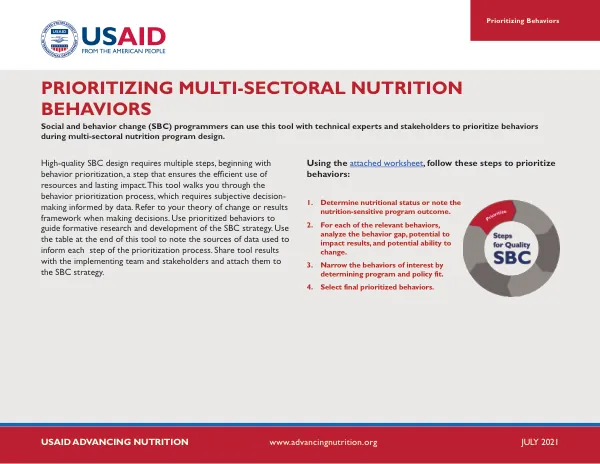
These behaviors are essential for achieving program outcomes, such as reducing stunting, underweight, wasting, and anemia in children under five. The tool requires subjective decision-making informed by data, and users are advised to refer to their theory of change or results framework when making decisions. The tool guides users through a four-step process to prioritize behaviors. The first step involves determining the nutritional status or noting the nutrition-sensitive program outcome. This step requires identifying the current nutritional status of the target population at the national, sub-national, or other level. Where nutritional status is not the direct outcome of a program, users note the desired program outcome. The second step involves analyzing the behavior gap, potential to impact results, and potential ability to change for each relevant behavior. Users list the behaviors that drive the outcomes and review data to determine the behavior gap and potential to impact results for each behavior. The potential to impact results is a judgment based on the behavior gap and the importance of the behavior to the desired outcome. Users score each behavior with a number from 1 to 5, with 1 being the lowest priority and 5 being the highest. If data does not exist, users note this. The third step involves narrowing the behaviors of interest by determining program and policy fit. Users write down the 5 to 8 behaviors with the highest average in step 2 and give weight to those with a "yes" from the final column of step 2. They carefully consider any behaviors with a "no" in the final column of step 2 that are also highly ranked and determine program fit based on the project or organization's time, competencies, and resources needed to promote the practice(s). The fourth step involves selecting final priority behaviors. Users select 3-5 behaviors with the strongest program fit from step 3, while making sure these behaviors align with policy priorities. If users find it difficult to narrow to 3-5 behaviors, they can select more as priority behaviors, but plan to address the behaviors in phases. The tool provides illustrative nutrition-sensitive behaviors, such as agriculture and food security, market-based approaches, economic strengthening, livelihoods, and social protection, water, sanitation, and hygiene, family planning and reproductive health, education, and nurturing care for early childhood development. These behaviors are essential for addressing the root causes of malnutrition and improving nutrition outcomes. The document was produced for the U.S. Agency for International Development and was prepared under the terms of contract 7200AA18C00070 awarded to JSI Research & Training Institute, Inc. The contents are the responsibility of JSI and do not necessarily reflect the views of USAID or the U.S. Government. The tool requires users to document data, research, and planning materials consulted for decision-making at each step. Users can use the optional table to document resources consulted, including the USAID ACCELERATE project and Pinchoff et al. 2019.