MAKING CENTS INTERNATIONAL
Mapping Haiti's Criminal Dynamics: Conclusions and Recommendations Brief
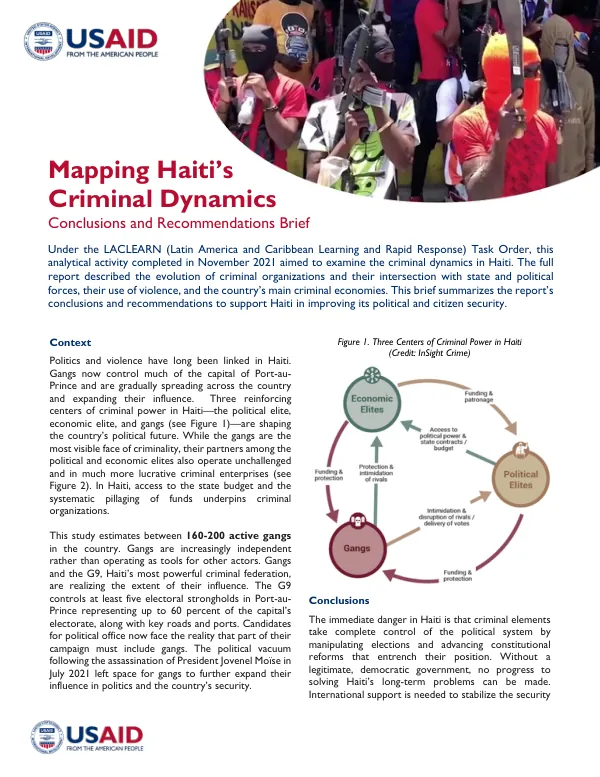
Haiti's criminal dynamics are shaped by three reinforcing centers of power: the political elite, economic elite, and gangs.
2021 · 2 pages
Sign in to readA free account is required to download.
Abstract
These groups operate in a complex web of influence, with gangs being the most visible face of criminality. However, their partners among the political and economic elites also engage in lucrative criminal enterprises, often with impunity. The study estimates that between 160-200 active gangs operate in Haiti, with many becoming increasingly independent from other actors. The G9, Haiti's most powerful criminal federation, controls at least five electoral strongholds in Port-au-Prince, representing up to 60% of the capital's electorate. This has significant implications for the country's politics, as candidates for office now face the reality that part of their campaign must include gangs. The assassination of President Jovenel Moïse in July 2021 created a power vacuum that allowed gangs to expand their influence in politics and security. Without a legitimate, democratic government, Haiti's long-term problems cannot be solved. International support is needed to stabilize the security situation and prevent criminal elements from taking complete control of the political system. The study's conclusions and recommendations aim to support Haiti in improving its political and citizen security. Key recommendations include creating the conditions for free and fair elections, establishing an independent police force, strengthening the rule of law, ensuring delivery of basic services, and establishing independent media and non-governmental organizations. Additionally, a public relations campaign should be employed to undermine gang influence, and efforts should be made to stop the flow of weapons to Haiti and help the country keep watch of dangerous gang deportees. The Haitian government should publicly request international support to stabilize the security situation, with clear expectations established for the duration and scope of the assistance. This support should help build public confidence in the electoral process and allow for fair elections to take place. Establishing an independent police force, combined with community policing and strengthening the Office of the Inspector General, will help the state challenge gangs that have set themselves up as local governing structures. Strengthening the rule of law is also crucial, with one model being the International Commission Against Impunity in Guatemala (CICIG). The Haitian state's dependence on foreign assistance to provide basic services must end, as this has fueled corrupt elites and criminal gangs. Independent media and non-governmental organizations are also essential in promoting and protecting children, as well as fighting corruption and organized crime. Employing a public relations campaign to undermine gang influence is critical, as gangs are increasingly using sophisticated social media campaigns to present themselves as credible actors. Credible and fact-based reporting at national and community level must counter these campaigns. Finally, addressing arms trafficking networks and helping Haiti keep watch of dangerous gang deportees will also be essential in addressing the country's security challenges.