USAID DEC
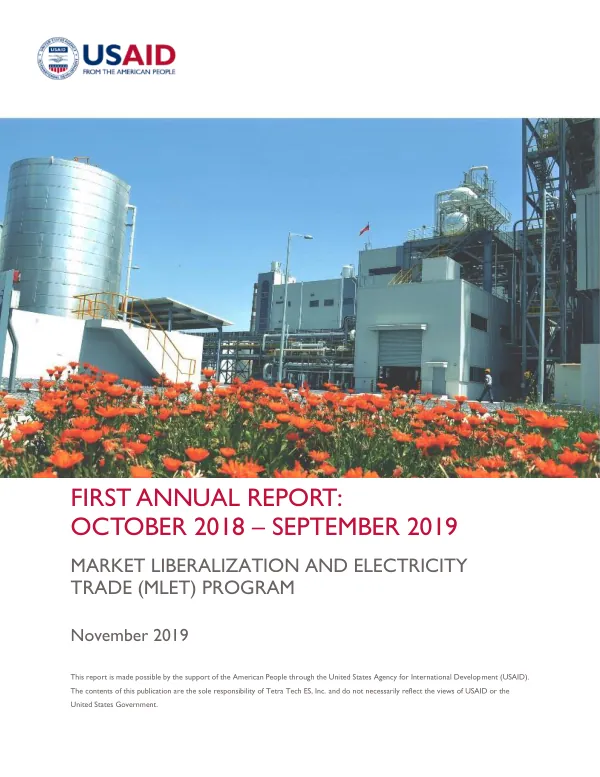
Market Liberalization and Electricity Trade (MLET) Program First Annual Report October 2018 – September 2019
Sign inSYNERGY INTERNATIONAL SYSTEMS, INC.
Market Liberalization and Electricity Trade (MLET) Program First Annual Report October 2018 – September 2019
The Market Liberalization and Electricity Trade (MLET) Program is a five-year initiative funded by the United States Agency for International Development (USAID) to improve the Armenian electricity market and support expanded electricity trade with Georgia.
2019 · 61 pages
Sign in to readA free account is required to download.
Abstract
The program aims to help key energy sector institutions, including the Ministry of Territorial Administration and Infrastructure (MTAI), the Public Services Regulatory Commission (PSRC), the Market Operator (MO), and the System Operator (SO), adopt legal-regulatory reforms, accelerate implementation of market liberalization mechanisms, and strengthen Armenia-Georgia dialogue on cross-border trade. The MLET Program's First Year Work Plan reflected a coordinated approach developed in close collaboration with these counterparts to support the Government of Armenia's (GOAM) Action Plan for Liberalization of the Republic of Armenia Energy Sector Electricity Market and Development of Cross-Border Trade. The program's specific activities were directed to support the introduction of the Armenia Electricity Market New Model and Electricity Trade Mechanism Concept, as adopted by the PSRC in its Resolution Number 289 of July 18, 2018. During its first full year of implementation, the MLET Program achieved significant progress toward development and introduction of the new Wholesale Electricity Market (WEM). The program supported the PSRC's approval of a full package of new Licensing Rules and Licenses in December 2018 and collaborated with the MO team to prepare a full package of the draft WEM Rules and Contract and Retail Market Rules and Contracts, which were submitted to the PSRC for review and approval in July and September 2019, respectively. The program also worked with the SO to support their timely delivery of the revised Transmission Network (Grid) Code and an updated set of Armenian Power Sector Reliability and Security Indicators in July 2019. The MLET Program's main challenges during its first year related to ensuring key stakeholder focus and continuity of actions through the political developments following the major realignment in the Spring of 2018, adapting the approach to development of the Market Management System (MMS) software for implementation of the WEM Rules, and the relative slowness of the SRIE team in advancing the Least Cost Energy Development Plan. However, the program was able to minimize the impact of these delays through timely and proactive management actions. The MLET Program proposal had left open the precise path for development of the MMS software, and the process of agreeing with all key local stakeholders on the approach to use a local IT company for the development required significant additional due diligence, procurement design, and risk management. The successful award of this work to the local IT firm Synergy International Systems, Inc. in June 2019 was the outcome of effective collaboration and coordination between the MLET team, USAID, and local stakeholders. During its first year of implementation, the MLET Program was also able to maintain momentum in cross-border dialogue between Armenia and Georgia on electricity trade. Following the successful reestablishment of the Armenia-Georgia Energy Sector Joint Working Group (JWG) in December 2018, a second JWG meeting was held in Tbilisi in late September 2019 to move the agenda forward.
Related documents