PLANNING AND DEVELOPMENT COLLABORATIVE INTERNATIONAL, INC. (PADCO)
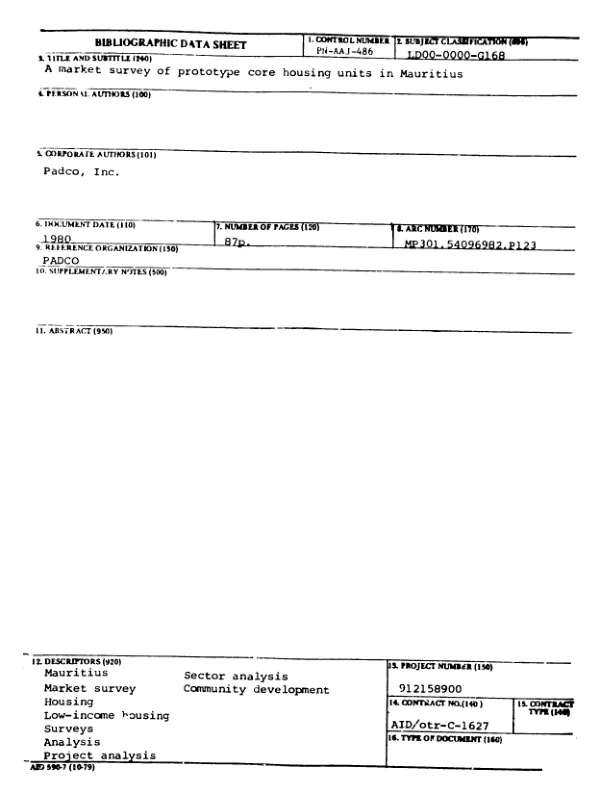
MARKET SURVEY OF PROTOTYPE CORE HOUSING UNITS IN MAURITIUS
Following an AID-sponsored sheltor sector assessment in 1977, the Government of Mauritius decided to replace the subsidized high-standard dwellings used in previous post-cyclone housing reconstruction programs with smaller and more cost-efficient shelter units.
1970
Sign in to readA free account is required to download.
Abstract
Before embarking on a large-scale program, however, a market survey was conducted to determine the acceptability and affordability of the core units among lower-income families. This report analyzes the survey data and presents the implications for a possible A.I.D. Housing Guaranty loan. Two prototype core housing units were built at six demonstration sites throughout the island and the survey was administered to potential occupants, the majority of whom met the below-median income requirements. Principal findings of the survey were that 79% of those wanting a core house need to have the land supplied by the government, 99% would be willing and able to pay for it, 70% were willing to move to occupy a core house (although there was a strong preference to stay in one of the five major urban areas), and Mauritius suffers a shortage of permanent housing given the high percentage of dwellings made from iron or tin. The principal implications of the survey for low-cost shelter projects are: (1) there is ample need and effective demand among the potential target group to justify a Housing Guaranty Program; (2) low-income shelter projects should concentrate on the five principal municipalities; (3) serviced sites should be offered with building loans to those who prefer this option to core houses; (4) the houses should have two small rooms rather than one large room and be sufficiently reinforced to allow for eventual vertical expansion; (5) due to a high percentage of employed respondents, the present system of collecting mortgage loans through salary deduction would be feasible for many low-income households; (6) because the potential beneficiaries include a significant proportion of households headed by women, the legal and social status of women should be taken into account in project design. Appended are designs of prototype core houses and the survey questionnaire.
Related documents
Documents in this collection
 1999
1999USAID DEC
Rebuilding shelter after natural disasters : three decades of USAID experience in Latin America and the Caribbean
Open record 1996
1996USAID DEC