AGENCIA DE LOS ESTADOS UNIDOS PARA EL DESARROLLO INTERNACIONAL
MATERIAL DE APOYO PROYECTO EDUCACIÓN PARA LA NIÑEZ Y JUVENTUD
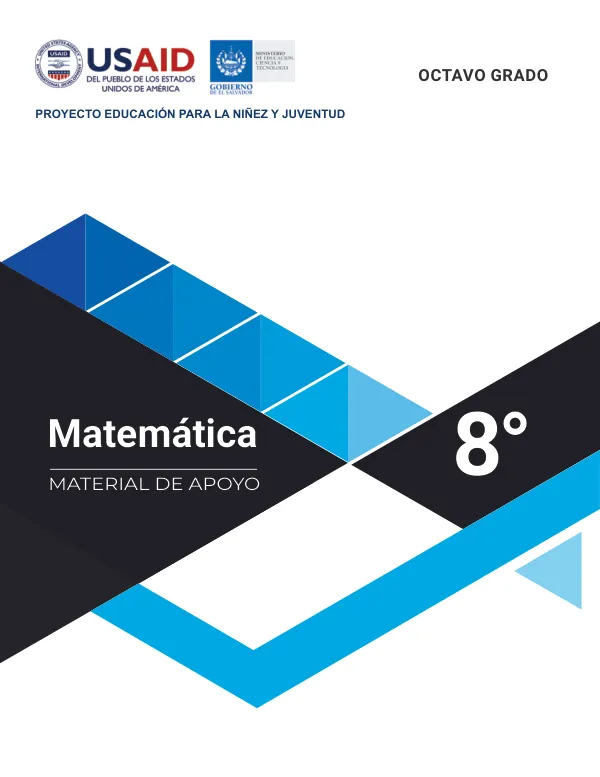
The Ministry of Education, Science and Technology, in collaboration with the National Directorate of Education for Young People and Adults, has developed a support material for students in the eighth grade.
2019 · 164 pages
Sign in to readA free account is required to download.
Abstract
This material is part of the Education for Children and Youth Project (ECYP), which is supported by the United States Agency for International Development (USAID). The project aims to improve educational opportunities for vulnerable and disadvantaged students in the third cycle, as well as young people between the ages of 9 and 24 who are not in school. The project focuses on municipalities with high crime rates. The main partners of the project include the Ministry of Education, Science and Technology, the Fundación para la Educación Integral Salvadoreña (FEDISAL), and other institutions such as Family Health International (FHI 360), Asociación Institución Salesiana (AIS), and Universidad Don Bosco (UDB). The project has several objectives, including improving educational outcomes for students in the second and third cycles, increasing access to educational opportunities for non-school youth, and providing school supplies to damaged schools. Additionally, the project aims to support emergency response efforts in the event of natural disasters. The support material is designed to provide students with the necessary information and skills to succeed in their studies. It covers various topics, including mathematics, and is intended to be used in conjunction with other educational resources. The material is part of a broader effort to improve educational outcomes and increase access to educational opportunities for vulnerable and disadvantaged students. The project is implemented in several municipalities, including those with high crime rates. The project's partners work together to provide support and resources to students, teachers, and schools. The project's goals are aligned with the national education plan, which aims to improve educational outcomes and increase access to educational opportunities for all students. The support material is designed to be flexible and adaptable to the needs of students. It includes a range of resources, including textbooks, workbooks, and online materials. The material is intended to be used in conjunction with other educational resources, such as teachers and peers. The project's impact is expected to be significant, with improved educational outcomes and increased access to educational opportunities for vulnerable and disadvantaged students. The project's partners are committed to working together to achieve these goals and to providing support and resources to students, teachers, and schools. The project's evaluation will focus on measuring the impact of the project on educational outcomes and access to educational opportunities. The evaluation will also assess the effectiveness of the project's strategies and identify areas for improvement. The project's findings will be used to inform future educational initiatives and to improve educational outcomes for all students. The project's sustainability is a key consideration, with a focus on building capacity and ensuring that the project's gains are sustained over time. The project's partners are committed to working together to ensure the project's long-term success and to providing ongoing support and resources to students, teachers, and schools. The project's geographic focus is on several municipalities in El Salvador, including those with high crime rates. The project's context is one of limited access to educational opportunities and resources, particularly for vulnerable and disadvantaged students. The project's goals are aligned with the national education plan, which aims to improve educational outcomes and increase access to educational opportunities for all students. The project's timeframes are aligned with the national education plan, with a focus on improving educational outcomes and increasing access to educational opportunities over the next several years. The project's recommendations are based on a thorough analysis of the educational needs and challenges facing vulnerable and disadvantaged students in El Salvador.
Related documents