USAID DEC
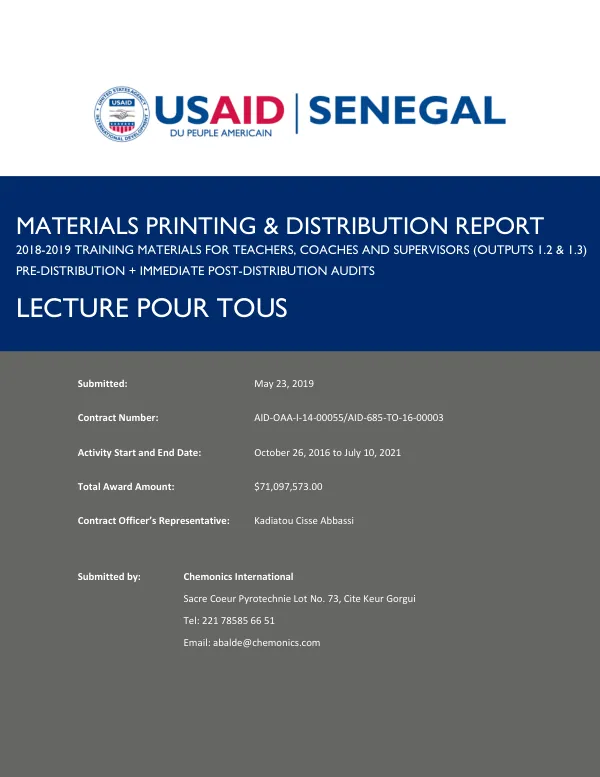
MATERIALS PRINTING & DISTRIBUTION REPORT 2018-2019 STUDENT AND TEACHER MATERIALS, TRAINING MATERIALS FOR COACHES AND SUPERVISORS (OUTPUTS 1.1 & 1.3) 90 DAYS POST-DISTRIBUTION AUDIT
Sign inCHEMONICS
MATERIALS PRINTING & DISTRIBUTION REPORT 2018-2019 STUDENT AND TEACHER MATERIALS, TRAINING MATERIALS FOR COACHES AND SUPERVISORS (OUTPUTS 1.1 & 1.3) 90 DAYS POST-DISTRIBUTION AUDIT
The Senegalese government, through the Ministry of National Education (MEN), and with technical assistance from USAID, has launched a program of primary reading reforms called "Lecture Pour Tous" (Reading For All).
2019 · 43 pages
Sign in to readA free account is required to download.
Abstract
This program aims to significantly and measurably improve school reading performance among students in the first three years of public primary school and equivalent classes in the daaras within the project's scope. Lecture Pour Tous is a five-year program (2016–2021), and aims to improve the reading performance of targeted students in a significant, sustainable, and scalable way. To achieve this, the program aims to achieve three major outcomes, namely: 1) improving reading instruction in the early grades of public primary schools and daaras; 2) improving reading instruction in primary school; and 3) improving the engagement of parents and communities in early grade reading support. Under Outcome 1 of the program, notable outputs include: 1.1 - Reading materials for the early grades in national languages based on research are available in classes, 1.2 - Improved teacher skills in teaching primary reading based on research, and 1.3 - Improvement of coaching and supervision of the early grade reading instruction. Lecture Pour Tous, in collaboration with the MEN, carried out the distribution of teaching materials and coaching and supervision training materials for the school year 2018-2019 in the six regions of the project (Diourbel, Fatick, Kaffrine, Kaolack, Louga, and Matam). The distribution of these materials was confirmed by pre-distribution and immediate post-distribution audits conducted and submitted to USAID and the MEN. The 90-day post-distribution audit for Output 1.1 teaching materials consisted of an external and virtual audit via calls and SMS made to schools and beneficiaries by Cresus Platinum Group (CPG) through a call center, and an internal survey conducted in the field by the Lecture Pour Tous program MEL (Monitoring, Evaluation, and Learning) team. This audit was carried out through two field visits to the beneficiaries of these materials. The quantitative survey conducted among 100% of the schools benefiting from the distribution of teaching materials and 30% of the beneficiaries of the coaching materials through SMS and telephone calls made by CPG during the period from 10 April to 10 May 2019, and a qualitative field survey conducted through visits to targeted schools based on a representative sample of 10% randomly drawn from 249 schools (or 7.39% of schools targeted by the program this year) and 21 daaras carried out by LPT's MEL team during the period from 04 to 15 March 2019. The data collected during these two surveys were analyzed and presented in this report, which is a synthesis of the data from these two sources of information. This data served as the basis for writing this audit report and confirms and complements the conclusions of the immediate post-distribution audit reports that were initially produced. The ratios required for Output 1.1 are a class book and a homework book for each student, a guide for each teacher, a set of graded booklets per 10 students, and a chart per CI classroom. As for Output 1.3, the main support for coaching and supervision consists of the Practical Guide to Coaching and Supervision. The ratios for Output 1.3 material are a coaching-supervision guide per school principal and inspector from targeted IEFs. The 90-day post-distribution audit for Output 1.3 material consisted of an external survey also conducted by CPG through calls and SMS to 30% of the principals and inspectors in the regions targeted. At the end of this audit, after the analysis and comparison of the results of the external survey conducted by CPG and the field survey conducted by LPT's MEL team, the data collected during these two surveys were analyzed and presented in this report, which is a synthesis of the data from these two sources of information. This data served as the basis for writing this audit report and confirms and complements the conclusions of the immediate post-distribution audit reports that were initially produced.