USAID DEC
Maternal and Child Survival Program Ending Preventable Child and Maternal Deaths in Haiti
Sign inJHPIEGO
Maternal and Child Survival Program Ending Preventable Child and Maternal Deaths in Haiti
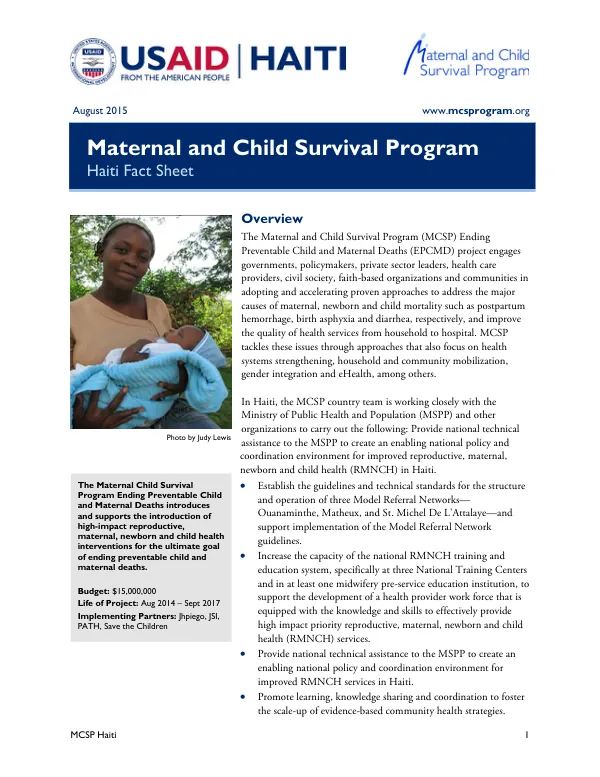
The Maternal and Child Survival Program (MCSP) Ending Preventable Child and Maternal Deaths (EPCMD) project in Haiti engages governments, policymakers, private sector leaders, health care providers, civil society, faith-based organizations, and communities in adopting and accelerating proven approaches to address the major causes of maternal, newborn, and child mortality.
2015 · 2 pages
Sign in to readA free account is required to download.
Abstract
The project focuses on health systems strengthening, household and community mobilization, gender integration, and eHealth, among others. The MCSP country team in Haiti works closely with the Ministry of Public Health and Population (MSPP) and other organizations to provide national technical assistance to create an enabling national policy and coordination environment for improved reproductive, maternal, newborn, and child health (RMNCH) in Haiti. This includes establishing guidelines and technical standards for the structure and operation of three Model Referral Networks: Ouanaminthe, Matheux, and St. Michel De L'Attalaye. The project also aims to increase the capacity of the national RMNCH training and education system, specifically at three National Training Centers and in at least one midwifery pre-service education institution. In its first year, MCSP EPCMD Haiti achieved several milestones. The project developed communication and transport protocols for establishing operational Model Referral Networks, revised the National Manual on Referral and Counter Referral Systems, and provided technical assistance to MSPP and LMG on piloting the referral and counter-referral tools. Additionally, the project established three National Training Centers with a pool of 19 staff trained as trainers in MNH skills standardization, including high-impact interventions such as Basic Emergency Obstetric and Neonatal Care, Helping Babies Breathe, and Essential Care for Every Baby. The project also advanced an enabling national environment through the revitalization of technical working groups, the introduction of key policies and guidelines requiring revision, and MSPP approval for piloting high-impact interventions, such as the provision of misoprostol for postpartum hemorrhage as a community intervention. Furthermore, the project mapped and profiled 36 civil society organizations engaged in community health. The MCSP EPCMD project in Haiti is supported by the American people through the United States Agency for International Development (USAID) under the terms of the Cooperative Agreement AID-OAA-A-14-00028. The project's ultimate goal is to introduce and support the introduction of high-impact reproductive, maternal, newborn, and child health interventions to end preventable child and maternal deaths.
Related documents