CAROLINA POPULATION CENTER AT THE UNIVERSITY OF NORTH CAROLINA AT CHAPEL HILL
MEASURE Evaluation Helps PEPFAR Deliver Results
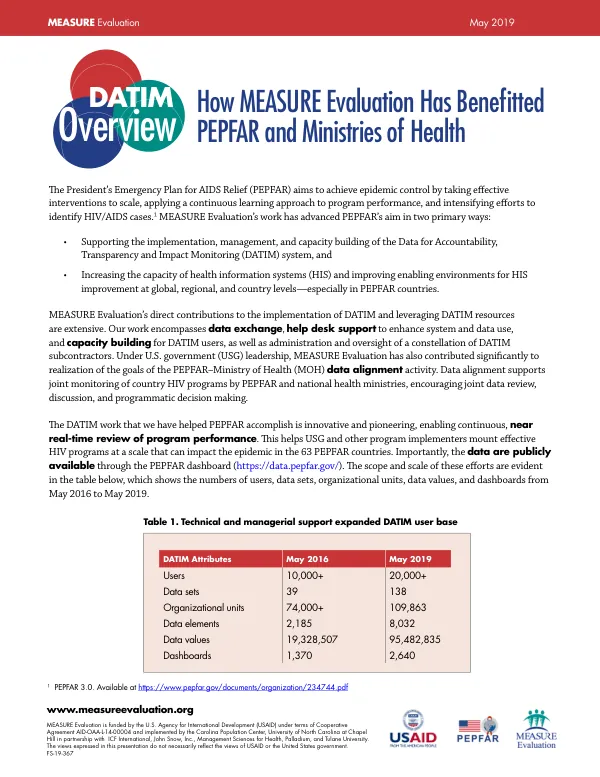
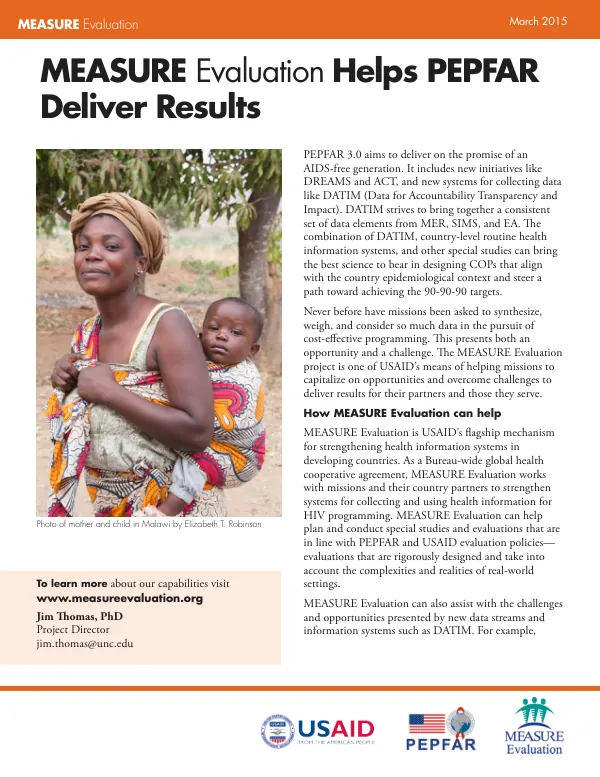
The PEPFAR 3.0 initiative aims to deliver on the promise of an AIDS-free generation by introducing new initiatives such as DREAMS and ACT, and new systems for collecting data like DATIM.
2015 · 2 pages
Sign in to readA free account is required to download.
Abstract
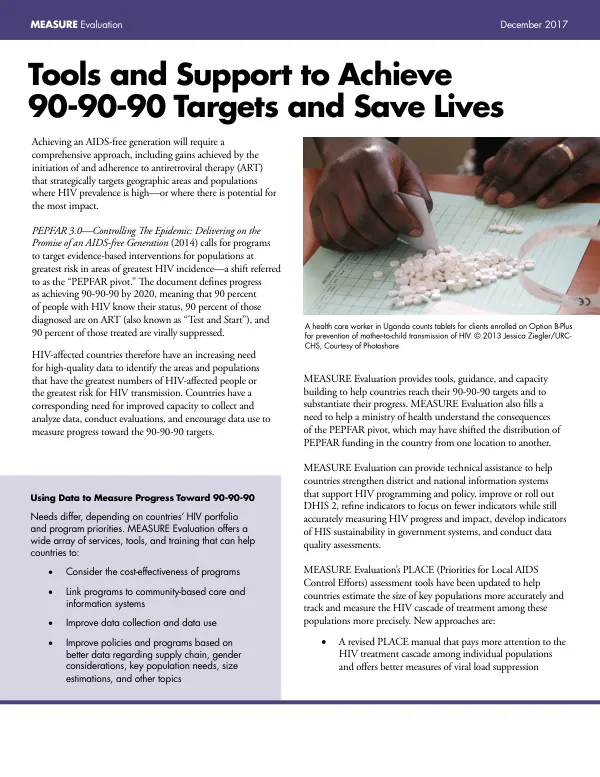
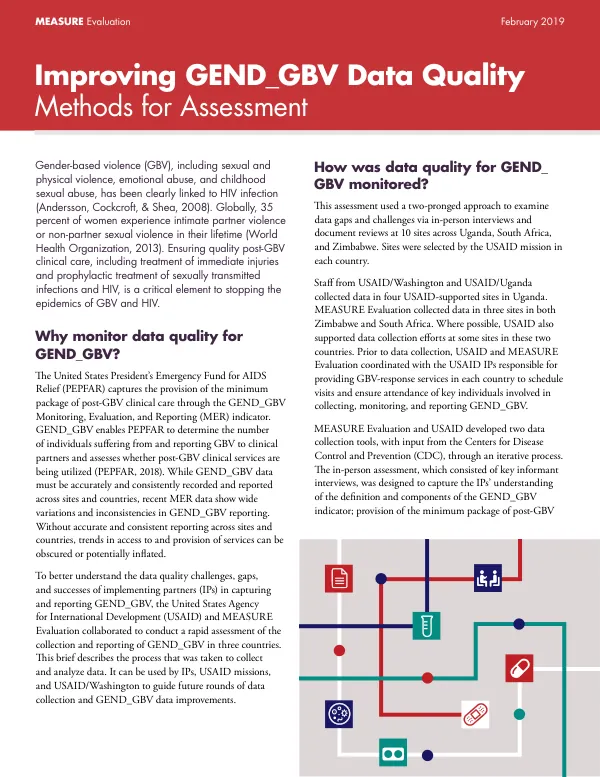
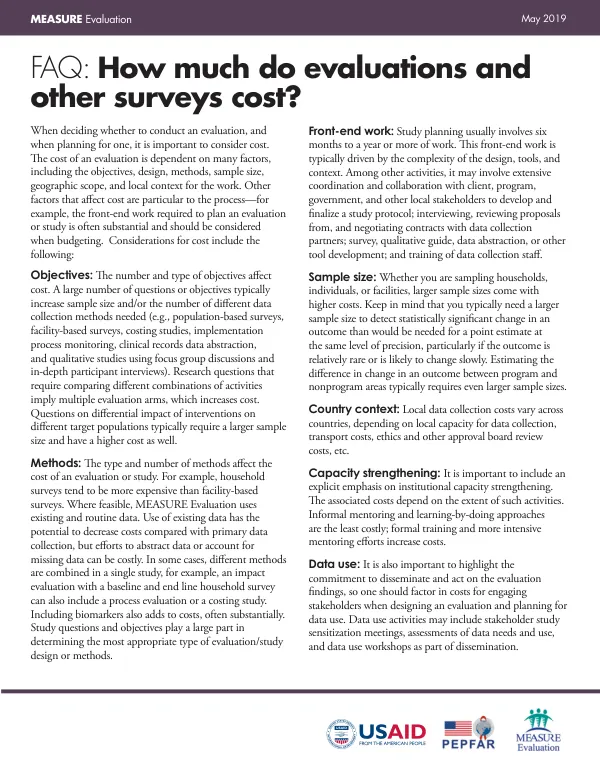
DATIM brings together a consistent set of data elements from MER, SIMS, and EA to provide a comprehensive understanding of the country epidemiological context. This data is used to design Country Operational Plans (COPs) that align with the country's needs and steer a path toward achieving the 90-90-90 targets. The MEASURE Evaluation project is one of USAID's means of helping missions to capitalize on opportunities and overcome challenges to deliver results for their partners and those they serve. MEASURE Evaluation is USAID's flagship mechanism for strengthening health information systems in developing countries. As a Bureau-wide global health cooperative agreement, MEASURE Evaluation works with missions and their country partners to strengthen systems for collecting and using health information for HIV programming. MEASURE Evaluation can help plan and conduct special studies and evaluations that are in line with PEPFAR and USAID evaluation policies. These evaluations are rigorously designed and take into account the complexities and realities of real-world settings. MEASURE Evaluation can also assist with the challenges and opportunities presented by new data streams and information systems such as DATIM. For example, MEASURE Evaluation can provide expertise in costing, including helping with interpretation and supplementation of expenditure analysis data, planning for the collection, use, and analysis of new MER elements, and applying geospatial science expertise to help with the mapping and spatial analysis of SIMS data. MEASURE Evaluation strives to accomplish its goals through collaboration and coordination, capacity building, and knowledge sharing. The project is successful when it demonstrates strengthened collection, analysis, and use of routine health data; when a country's capacity to manage health information systems, resources, and staff is improved; when M&E methods, tools, and approaches are improved and applied to address health information challenges and gaps; and when capacity for rigorous evaluations is increased. MEASURE Evaluation services include capacity building and organizational development, technical assistance to write and implement protocols, technical assistance to implement and make operational data systems, capacity building for the collection, analysis, and use of HIV/AIDS data, and evaluating effective strategies and identifying barriers and challenges to scaling up programs. In Ghana, MEASURE Evaluation has been working with the Government of Ghana, with the support of USAID, as it evaluates the performance and impact of the national HIV prevention program for FSW and MSM. MEASURE Evaluation worked with the country's Technical Working Group for Key Populations to determine priority evaluation questions, map existing data sources, and make a plan for filling gaps in planned data collection. With the Ghana AIDS Commission, MEASURE Evaluation successfully brought together implementing partners, donors, and other stakeholders to plan for ongoing evaluation. The results are informing the COP 2015 planning. In Swaziland, MEASURE Evaluation will support the Ministry of Health, USAID, and USAID implementing partners to strengthen the collection, analysis, and use of routine health information and improve country-level capacity to manage those systems, resources, and staff. MEASURE Evaluation will work to build the leadership capacity of local partners, improve the health management information system, address data-informed decision making barriers, and increase the capacity of in-country partners to analyze, synthesize, and communicate data—particularly with maps.