USAID DEC
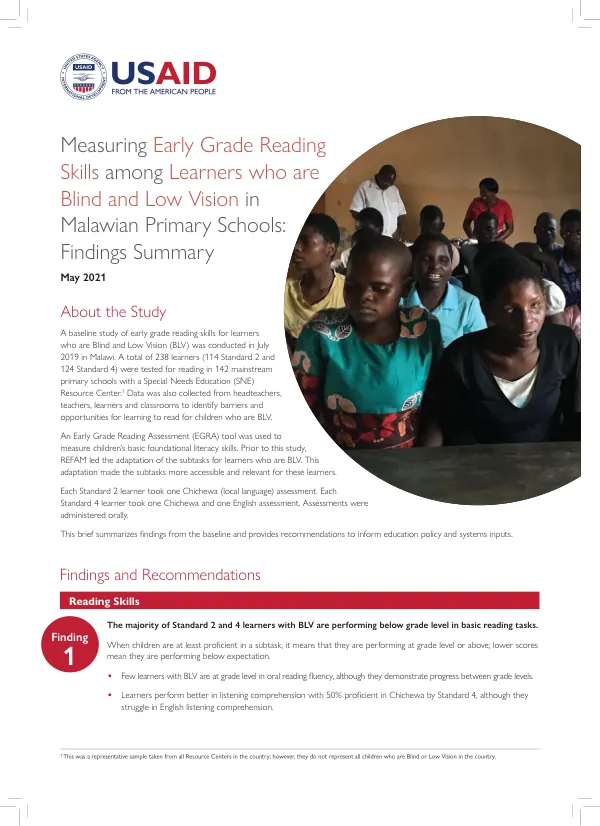
Measuring Early Grade Reading Skills among Learners with Learning Disabilities in Malawian Primary Schools: Findings Summary
Sign inINDONESIAN MINISTRY OF RESEARCH, TECHNOLOGY, AND HIGHER EDUCATION
Measuring Early Grade Reading Skills among Learners with Learning Disabilities in Malawian Primary Schools: Findings Summary
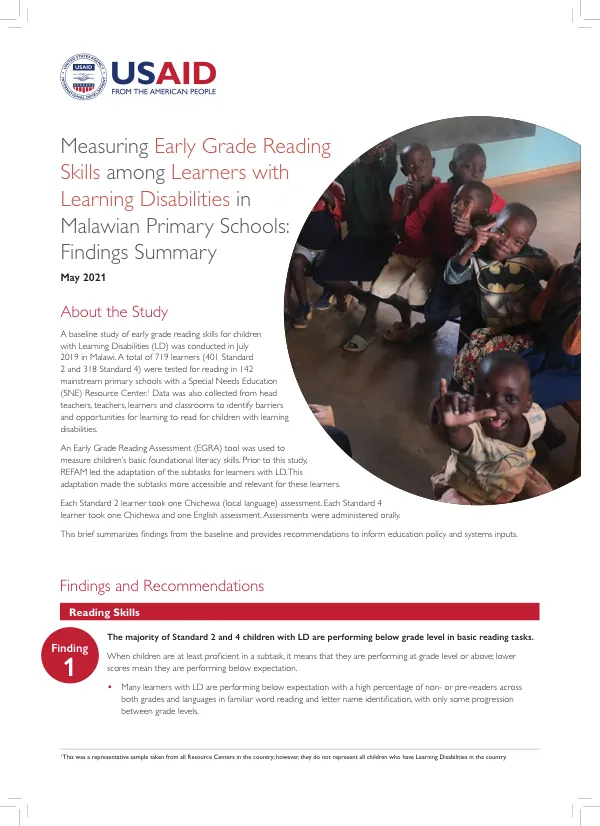
A baseline study of early grade reading skills for children with Learning Disabilities (LD) was conducted in July 2019 in Malawi.
2021 · 5 pages
Sign in to readA free account is required to download.
Abstract
The study involved 719 learners from 142 mainstream primary schools with a Special Needs Education (SNE) Resource Center. Data was collected from head teachers, teachers, learners, and classrooms to identify barriers and opportunities for learning to read for children with learning disabilities. The Early Grade Reading Assessment (EGRA) tool was used to measure children's basic foundational literacy skills. Prior to this study, REFAM led the adaptation of the subtasks for learners with LD, making the subtasks more accessible and relevant for these learners. Each Standard 2 learner took one Chichewa assessment, while each Standard 4 learner took one Chichewa and one English assessment. Assessments were administered orally. The majority of Standard 2 and 4 children with LD are performing below grade level in basic reading tasks. Many learners with LD are performing below expectation, with a high percentage of non- or pre-readers across both grades and languages in familiar word reading and letter name identification. There is some progression between grade levels, but the majority of learners are struggling to meet grade-level expectations. Most learners with LD lack an Individualized Education Plan (IEP), with only 28% having an IEP to guide their educational progress. The majority of teachers reported receiving support from the NRP in inclusive education, but many lack a formal special education qualification. The lack of IEPs and specialized training for teachers is a significant barrier to reading improvement for learners with LD. Recommendations have been made to address these challenges. The development of Individualized Education Plans and support for Universal Design for Learning are strategies for reading improvement that can help children progress gradually. Teachers should practice various teaching strategies, such as sequencing and segmentation, to increase learners' ability to recognize letters and words gradually. All SNE teachers supporting learners with disabilities should be included in capacity building training pertaining to the National Reading Programme to ensure additional support is available to learners with LD to improve reading in early grades. Resource centers should be provided with teaching and learning materials, supportive tools, and resources, and assigned teachers with varying specializations to better serve the needs of learners with disabilities in mainstream schools. These resources can be shared across a cluster of schools, reducing the cost burden of supplying each center. Schools and policymakers should strengthen measures for preventing school violence as well as structures for reporting and responding to abuse in order to create a safe learning environment for everyone, including learners with disabilities. The study also highlights the importance of parent and community participation in the education of learners with LD. Success in reading is partially dependent on learners' socio-economic status, with learners from wealthier homes more consistently engaging in positive reading practices and more frequently saying they like reading. Recommendations have been made to increase parent and community participation, as the education of learners with LD requires input and support from the entire community. The Reading for All Malawi (REFAM) Activity, funded by USAID and in partnership with Malawi's Ministry of Education, Science and Technology (MoEST), aims to improve reading among students with learning disabilities (LD), those who are blind or have low vision (BLV), and those who are Deaf or Hard of Hearing (DHH). REFAM is working to support systems for the screening, identification, placement, instruction, and testing of these learners so they can learn to read. As the MoEST works to strengthen community supports, it should focus on strategies to develop early reading among all children in Malawi, with extra efforts aimed at learners from lower income contexts.